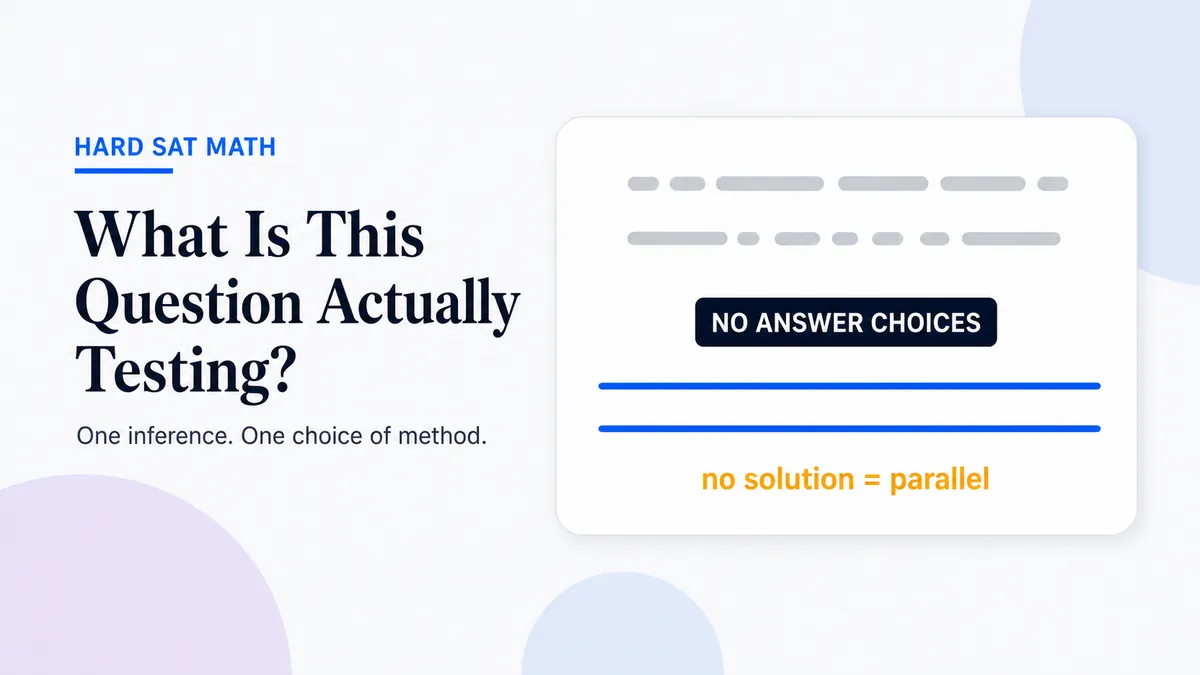
The short answer: Not algebra speed, and not Desmos. This question tests one inference — no solution means parallel lines, so the coefficient ratios must match — and one choice of method. Students who know both finish in under 90 seconds. Students who don’t quit at 96. Accuracy: 36% (Prism platform analysis, 2026).
The question
A student sent me this question with a one-line message: “How do I solve this using Desmos?” Before I answer that, try it yourself — the way you would on test day.
$23y−41x=32−23y$
$21x+23=py+29$
In the given system of equations, p is a constant. If the system has no solution, what is the value of p?
— Official College Board digital SAT question. There are no answer choices — you type in the answer yourself.
Why the popular method feels right
Desmos has been paying you all year. Graph it, drag it, read it — on plenty of questions that genuinely works. So the plan writes itself: type both equations, put a slider on p, drag until the lines look parallel.
This is where strong students lose the question. The plan has three breaks in it, and each one is built into the question:
The typing is the riskiest step. Four fractions in the first equation alone. One wrong denominator and the graph lies to you with full confidence.
Your eye can’t certify “parallel.” At p = 5.9, 6.0, and 6.1 the lines all look parallel. Looking parallel is not being parallel.
There are no answer choices. You can’t test options against the graph. You have to produce the exact value yourself — so the algebra is still waiting for you after all the dragging.
And to even start the plan, you needed the idea that no solution means parallel. The tool never spares you the concept. It adds slow, risky work on top of it.
What the question rewards
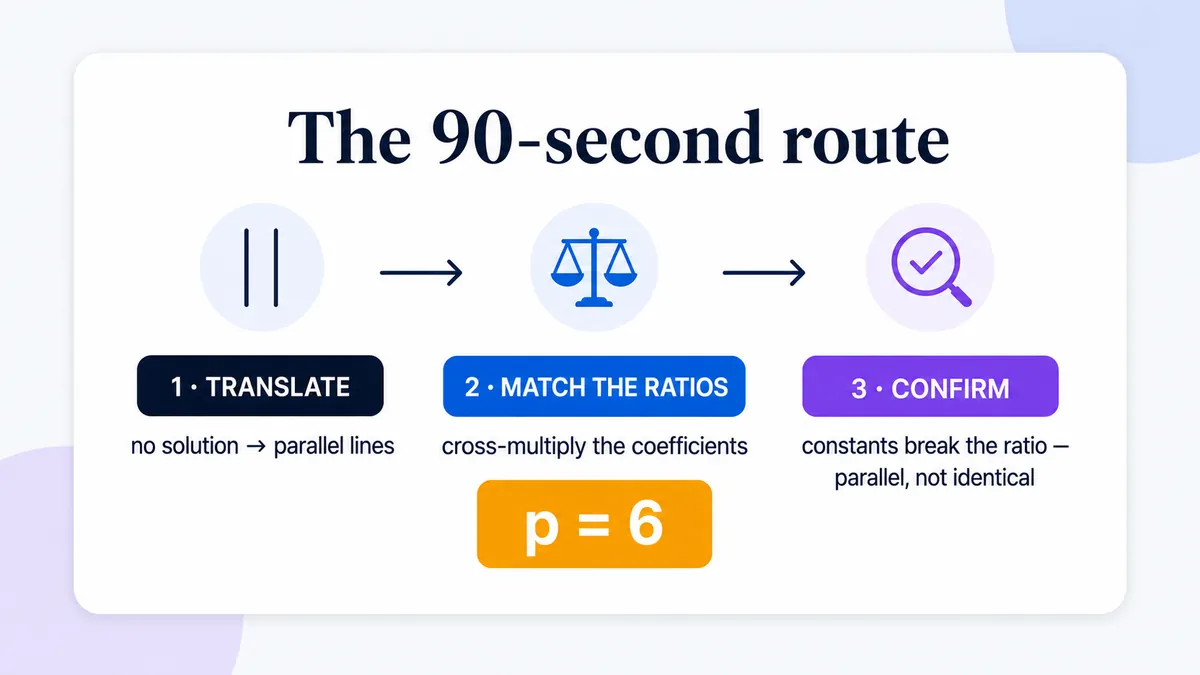
One inference, one clean method. No solution means the lines never meet. Lines that never meet are parallel — so the x- and y-coefficients sit in the same proportion, while the constants break it.
Tidy both equations into ax+by=c: −41x+3y=32 and 21x−py=3. Match the ratios and cross-multiply: (−41)(−p)=(3)(21), so 4p=23 — p = 6. One glance to confirm the constants don’t follow the same ratio (92, not −21): the lines are genuinely parallel, not the same line.
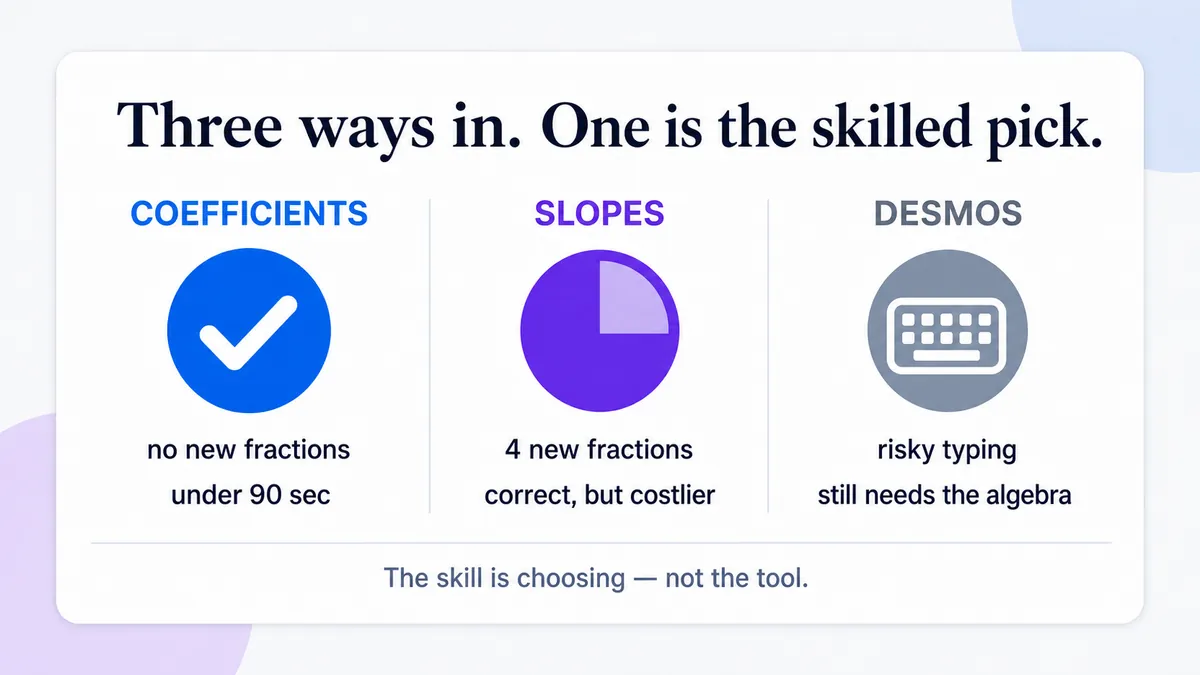
Two tidy-ups, one cross-multiplication, one glance. The only fractions you touched are the ones College Board printed. (Comparing slopes also works — it just manufactures four new fractions on the way, including a p in a denominator. Correct, but costlier.)
What the data says
36% accuracy. Two-thirds of students never get there.
Wrong answers stop at a median of 96 seconds. That is not the timestamp of a calculation error. It’s the timestamp of a student who never found the inference and watched the familiar moves connect to nothing.
Right answers take 2:48 at the median. Most solvers found a way — the slow way. The skilled solve is under 90 seconds, so the typical correct answer paid roughly double.
The chain behind those numbers is short: students miss this question because they can’t start, and they can’t start because “no solution” never became “matching ratios.” That’s the root cause. And once you have the root cause, the fix is a slam dunk — one sentence of translation, not fifty more drills.
The skill, named
This question tests two abilities, one after the other.
The first is translation. The question hands you a condition in words — no solution — and expects you to turn it into structure: two parallel lines, matching coefficient ratios. Most students who miss this question fall right here, at the first step. Not because the math is hard — because they never paused to ask what the condition actually means.
The second is choosing your method. Three roads lead to p = 6, and the question quietly tells you which one to take. The unknown is a letter, not a number — so a slider has nothing definite to land on. The fractions are messy — so every extra manipulation is a chance to slip. And you have to type the exact answer yourself — so “close enough” doesn’t exist. Every one of those features points to the coefficient route, and away from the calculator.
Neither ability is a trick. Both are exactly what your first college math course assumes you already have.
And there’s a bonus. The same picture answers the SAT’s cousin question — infinitely many solutions. Same setup, one difference: now the constants must match the proportion too, because the two equations have to be the same line. Understand one idea, and you can solve the whole family of questions built on it. That’s what understanding buys that memorization never will.
Run this every time
Translate before you touch anything. Say the condition as a structure sentence: “no solution = ratios match, constants don’t.” If you can’t say it, no method can start.
Pick your method from the question’s features. A letter for the unknown, messy fractions, no answer choices — that’s the question telling you: coefficients, not the calculator. Ten seconds of judgment.
Confirm the constants. Parallel, not identical. One glance.
Tonight, take your last three hard algebra misses and write, for each one, the structure sentence you never wrote on test day. Three sentences. If you can name what a question was testing, you own it — and that’s the ability this question was built to find.
A note on sources and figures
Question text: official College Board digital SAT item, reproduced for educational commentary and analysis, attributed to College Board.
Prism Learning platform analysis (2026): accuracy 36.2% (80 attempts); median 168s correct / 96s incorrect — from our 2,845-question analysis of official digital SAT questions with real student performance. The under-90-second skilled solve is our editorial estimate, consistent with the observed timing gap. Prism’s findings, not College Board figures.
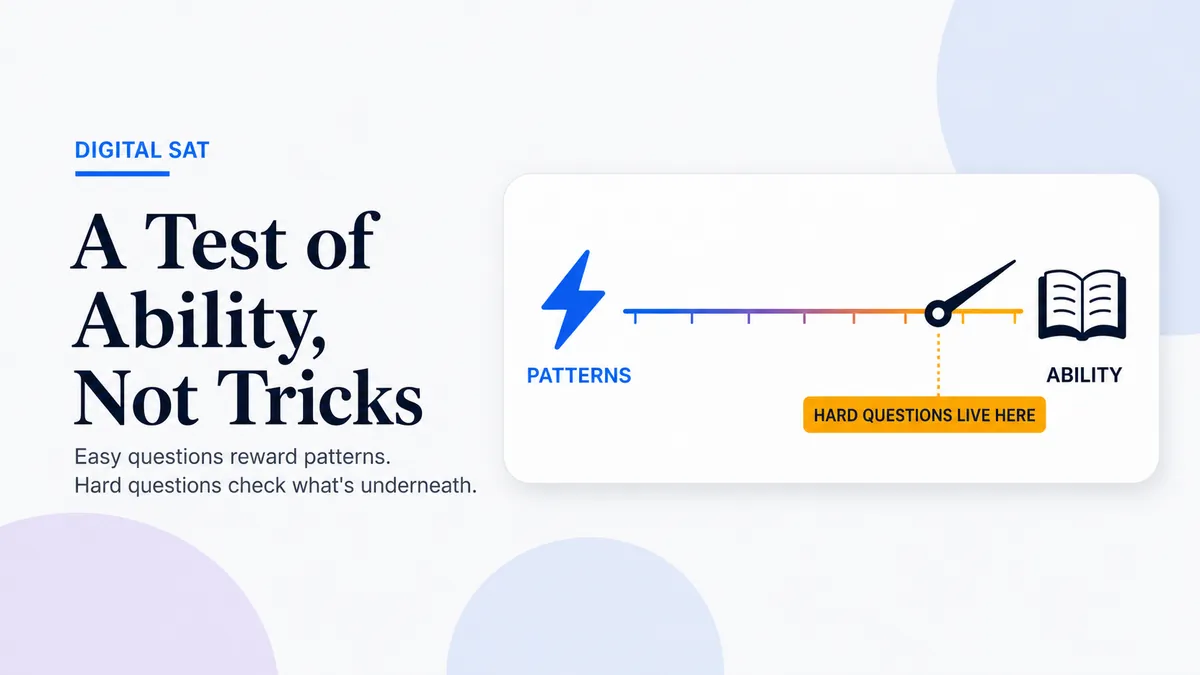
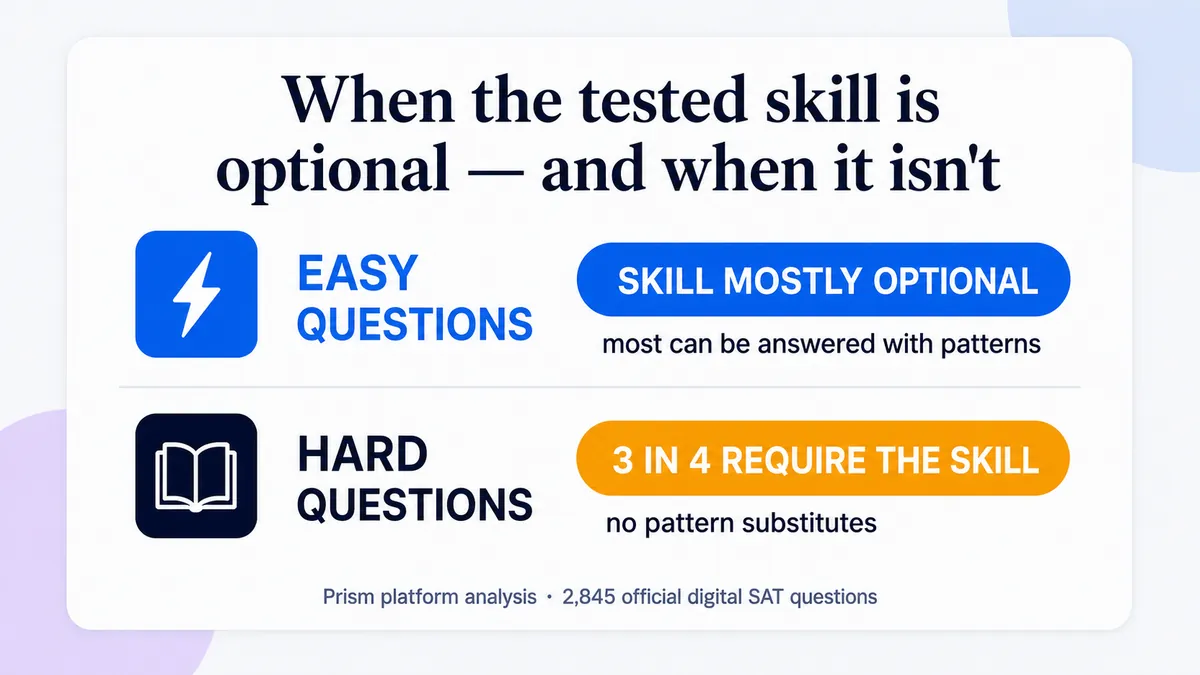
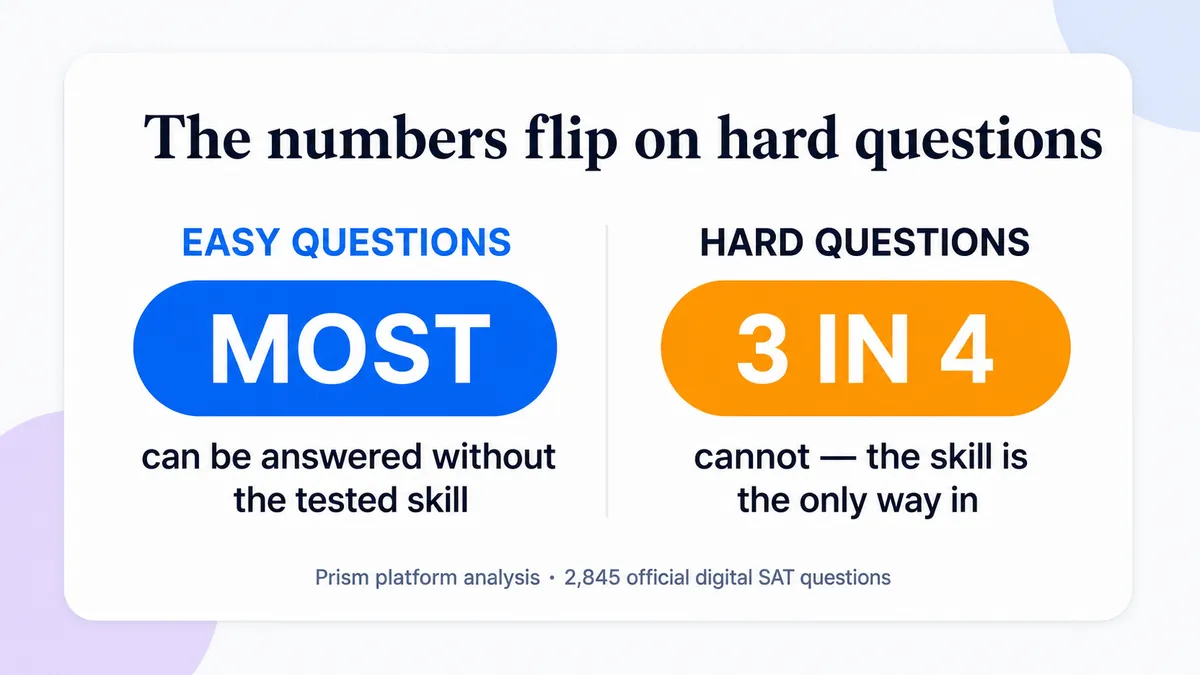
The short answer: The SAT is not a test of how many tricks you’ve memorized. It’s a test of ability — can you understand what you read, reason about what you know, and pick the right method for the problem in front of you. We analyzed 2,845 real digital SAT questions, and the pattern is unmistakable: on easy questions, the tested skill is optional — about 3 in 4 Math questions and nearly all Reading & Writing questions can be answered without it. On hard questions — the ones that decide whether you score 650 or 750 — that flips. Roughly 3 in 4 hard questions in both sections cannot be answered without the real skill. The test is built to let tricks carry you partway, and then check whether there’s ability underneath. The good news: that ability can be trained — and unlike a trick, you keep it for life.
Every week I get some version of the same question from a student. They’ve hit a hard Math problem, and they ask: “How do I solve this one with Desmos?” Or it’s Reading & Writing, and they want the elimination rule, the keyword pattern, the thing that gets them to the answer without the work.
I understand why. The internet is full of SAT “hacks,” and some of them genuinely work. But I want to show you what’s actually going on inside this test — because once you see it, you’ll stop asking “what’s the trick for this question?” and start asking a much better question: “what is this question testing?”
Those are two different mindsets. And the SAT — deliberately, by design — rewards one and punishes the other.
What do I mean by “a test of ability”?
I don’t mean it as a motivational line. I mean it in terms of how the test is actually built.
Every SAT question sits somewhere on a scale: at one end, questions you can answer with a memorized pattern — a grammar rule, a keyword match, a calculator routine. At the other end, questions where no pattern rescues you. You have to understand the passage, or understand the concept, or judge which of your methods actually fits — and that’s ability. Not “smartness.” Ability: a trained skill, applied under time pressure.
Here’s the part most students never realize: the SAT uses that scale as its difficulty dial. Easy questions live at the pattern end. Hard questions live at the ability end. So when your score climbs into the high 600s and stalls, the test isn’t asking you for more patterns. It’s asking you for something patterns can’t fake.
Let me prove it with one question. A real one — a hard one — and I’ll bet it’s exactly the kind you’d want to Desmos your way through.
What is this hard question actually testing?
Try it. It’s an official College Board question, and there are no answer choices — you type in the answer yourself:
$23y−41x=32−23y$
$21x+23=py+29$
In the given system of equations, p is a constant. If the system has no solution, what is the value of p?
— Official College Board digital SAT question.
Now watch me work it — and notice that the first move isn’t algebra at all. It’s an inference. No solution. What does that actually mean? It means these two lines never meet. Two lines that never meet are parallel — same direction, different position. That one connection — no solution → parallel — is the entire question. Everything after it is bookkeeping.
But here’s what most prep never tells you: from that one insight, there’s more than one way to get to the answer. And which way you pick is itself part of the test. Let me show you the two concept methods side by side.
Way 1 — compare the coefficients. Parallel lines, written as equations, have matching proportions: the x- and y-coefficients of one equation are the same multiple of the other’s, while the constants break the pattern. So I don’t solve for anything. I just tidy both equations into ax+by=c shape. First equation — add 23y to both sides: −41x+3y=32. Second — move things across: 21x−py=3. Now line up the ratios — 1/2−1/4=−p3 — and cross-multiply: (−41)(−p)=(3)(21), so 4p=23, and p = 6. One glance to confirm the constants don’t follow the same ratio — 32 against 3 is not −21 — so the lines are truly parallel, not the same line. Done. Two tidy-ups and one cross-multiplication. Well under ninety seconds.
Way 2 — compare the slopes. Also completely valid: put each equation into y=mx+b form and set the slopes equal. You’ll get 121=2p1 and the same p = 6. But look at what it costs. To get there you have to divide one equation through by 3 and the other by p, and in the process you create four brand-new fractions — 121, 92, 2p1, p3 — that the question never gave you. Every new fraction is a new chance to slip.
Both ways run on the same inference. Both should land inside a minute and a half — which is about what this question deserves from a student whose concepts are in order. But a skilled student doesn’t flip a coin between them. They pick the coefficient method, and they pick it for reasons: fewest moves, nothing gets divided, no new fractions get created — the only numbers you touch are the ones printed on the screen, and p stays out in the open where you can see it. That choice takes ten seconds to make and pays for itself immediately.
On our platform, this question runs at 36% accuracy. And the timing data tells the story in two layers. Students who get it wrong give up at a median of 96 seconds — they bail early because they never make the inference, quitting at almost exactly the moment a skilled student is typing 6 into the answer box. And the students who get it right? They take nearly three minutes — 2:48 at the median. They found a way to solve it — but most of them found a slow one. Two layers, one lesson: this question isn’t grading your arithmetic. It’s grading whether you can find the condition — and how well you choose your method once you have it.
“But can’t I just Desmos it?”
Now, the third way — the Desmos plan. And I want to be fair to it, because the student asking isn’t being lazy — they’re being strategic with the tools they have. Here’s what the Desmos route actually looks like: type in both equations, put a slider on p, and drag until the two lines look parallel.
Notice something, though. To know you’re looking for parallel lines, you already had to make the inference — no solution means parallel. The Desmos student isn’t skipping the concept. They can’t. Nobody can; that’s what makes this question hard.
So if the concept is needed either way, what’s wrong with Desmos here? Three things, and none of them is “it’s cheating”:
Entering these equations is where errors live. Four fractions in the first equation alone. One mistyped denominator and your whole screen is lying to you — confidently.
Your eye can’t certify “parallel.” A slider shows you lines that look parallel at p = 5.9 and at 6.1. Looking parallel is not being parallel.
There are no answer choices. You need the exact value. So after all the typing and dragging, you still have to do the algebra to confirm — the calculator saved you nothing.
So Desmos isn’t wrong because it’s a shortcut. Desmos is wrong for this question — slower, and easier to fumble, than the ninety-second coefficient method. On other questions, Desmos genuinely is the best move; our analysis flags plenty where it wins. That’s exactly the point. The real skill was never “algebra versus calculator.” The real skill is judgment: knowing all three ways, reading the question, and choosing the one this question rewards.
And here’s the finding that convinced me the SAT is grading judgment on purpose. In our analysis of the hard Math pool, on 205 of the 457 hard questions, the student data shows a faster, safer route that most students never took. You just watched it happen: on the question above, even the successful solvers averaged nearly three minutes — which tells you most of them took the long way, dividing through and juggling new fractions, when the coefficient move finishes in half the time. Think about what that means. The hard part of hard questions usually isn’t the computation. It’s the decision about how to attack them. That decision is ability. And you can’t memorize a decision.
The same test is hiding inside Reading & Writing
You might think this is a Math story. It isn’t. Here’s a hard official transition question:
A turtle shell appears external to the animal, protecting its body like armor. ______ the shell is often incorrectly assumed to be an exoskeleton, a rigid outer casing like that of a crustacean or an insect, when in fact it is an endoskeleton, a part of the turtle’s internal bone structure, more akin to a spine or a pair of ribs.
A) That being said, B) However, C) For instance, D) Hence,
— Official College Board digital SAT question.
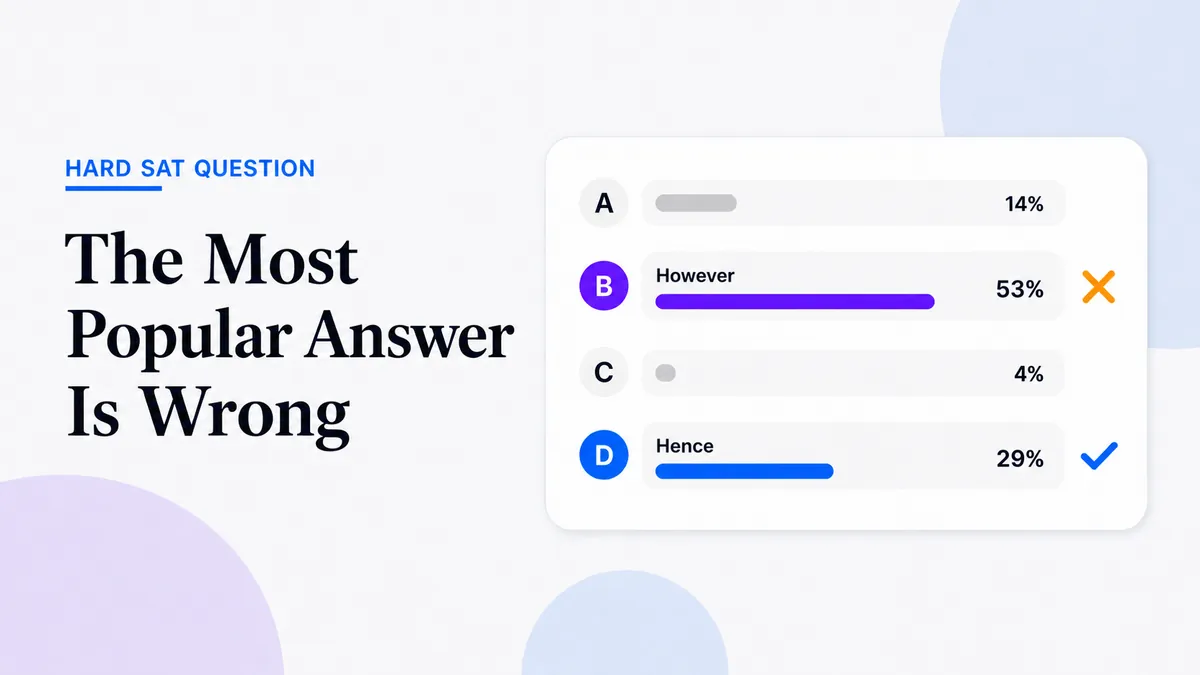
The pattern-matcher sees it instantly: “looks like armor… but it’s actually internal bone” — appearance versus reality, that’s a contrast, grab However. On our platform, 53% of students pick B. It’s the most popular answer in the room. And it’s wrong.
Read the logic — the actual logic, not the shape. The shell looks external. That’s precisely why people wrongly assume it’s an exoskeleton. The appearance doesn’t clash with the mistake; the appearance causes the mistake. Cause and effect. Hence. Only 29% get there. And this isn’t carelessness. Right and wrong answers took the same 28 to 29 seconds. Students read carefully and still missed, because they ran a pattern where the question demanded reasoning.
Same test, different section. In Math it checks whether you can draw the inference and pick your method. In Reading & Writing it checks whether you follow what the sentence actually says instead of what it resembles. Both times, one thing is being measured: is there ability under the technique?
Two questions. What about the other 2,843?
Fair. We ran this analysis on 2,845 real digital SAT questions — 1,465 Math, 1,380 Reading & Writing — asking, for every single one: can a student get this right without the skill it claims to test?
Easy questions: mostly yes. About 77% of easy Math questions can be answered without the tested idea. In Reading & Writing it’s more extreme: fewer than 1 in 25 easy questions truly require you to understand the passage.
Hard questions: mostly no. About 3 in 4 hard Math questions cannot be answered without the concept. About 7 in 10 hard Reading & Writing questions cannot be answered without genuinely understanding the passage — and most of the exceptions are grammar items where a mechanical comma rule happens to suffice.
It’s not your intelligence being filtered at the top of the test. It’s not your effort. It’s not your luck. It’s whether there is skill underneath your technique — because the test is built so that technique alone runs out exactly where the scores start to matter.
And once you see that, the whole “hacks” conversation changes. The tricks aren’t evil. The test simply knows about them. It lets them work on the questions that don’t separate anyone, and it quietly turns them off on the questions that do.
Here’s the part I absolutely love
If the SAT were really a test of tricks, then every hour you spent preparing would evaporate the day you closed Bluebook. It isn’t. The abilities this test checks on its hard questions — read something dense and follow its actual logic, connect a condition to what it implies, look at a problem and choose your method like a professional instead of reaching for the same tool every time — those are the abilities your first year of college assumes you have. They’re the ones that make you the student who handles rigor instead of drowning in it.
So when a hard question refuses to be hacked, it isn’t the test being unfair to you. It’s the test asking you, quietly, the only question colleges actually care about: can you think? Preparing for that question is never wasted. It’s the rare kind of test prep you keep for the rest of your life.
Here’s what I want you to do tonight. Take one hard question — Math or Reading & Writing, doesn’t matter. Before you touch it, say out loud: “What is this question testing?” Then pick your method on purpose, and say why — “Desmos, because the answer choices are graphable points,” or “coefficients, because no-solution is a proportion condition,” or “read the whole thing, because the logic lives in the passage.” One question, solved with judgment, teaches you more than twenty solved on autopilot. That habit — noticing what’s being tested and choosing your method on purpose — is the ability. Start building it tonight.
A note on sources and figures
Question text: both questions shown are official College Board digital SAT items, reproduced for educational commentary and analysis, and attributed to College Board.
Prism Learning platform analysis (2026): the 2,845-question dataset (1,465 Math + 1,380 Reading & Writing — every official question with real student performance data available to us); the without-the-skill rates by difficulty (Math: ~77% easy / ~25% hard; R&W: ~96% easy / ~32% hard, of which most are grammar-rule items); the 205-of-457 unused-faster-route finding; and the per-question statistics (no-solution system: 36.2% accuracy, median 168s correct / 96s incorrect; turtle transition: 34% accuracy, 53% choosing “However,” 28–29s median times). These are Prism’s own findings, not College Board figures, and per-question stats reflect our platform’s population.
Difficulty labels (easy/medium/hard) are College Board’s own designations on the source questions.
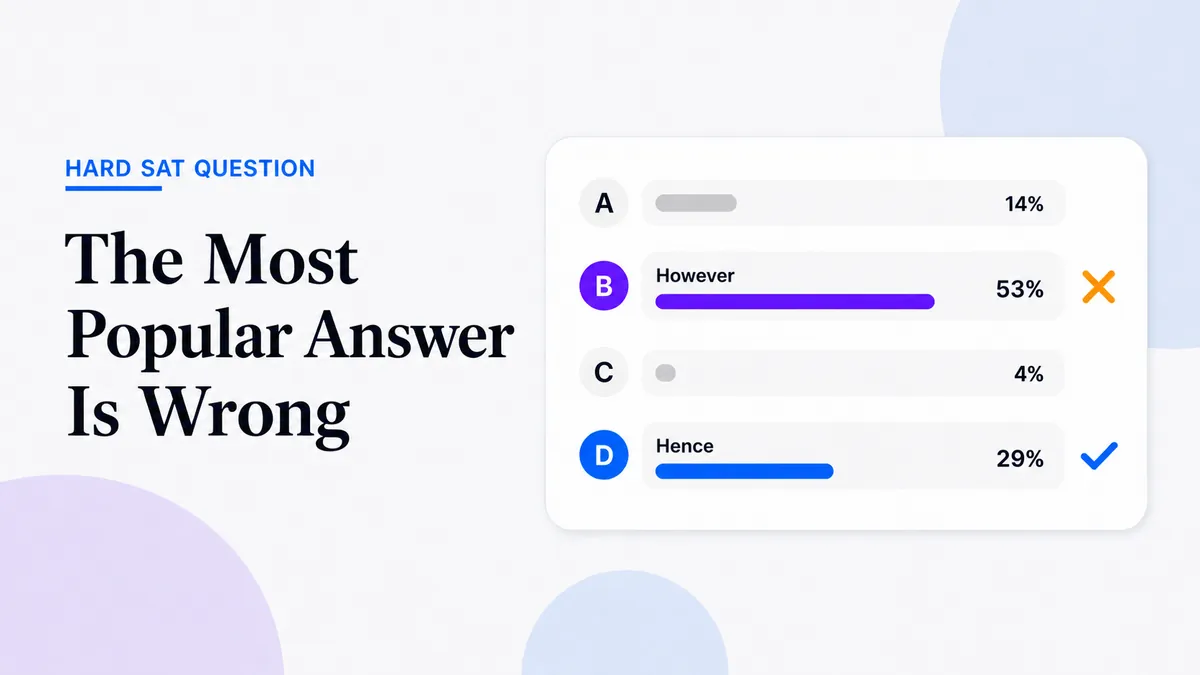
The short answer: On this official hard question, the trap answer is more popular than the correct one — 53% pick “However,” only 29% find “Hence.” And the times match (28 vs 29 seconds), so it isn’t carelessness. It’s pattern-matching, carefully executed. That’s the 750 test’s signature move (Prism platform analysis, 2026).
The question
I want to show you the single most revealing thing in our dataset — a question where the most popular answer in the room is wrong. Try it first, the way you would on test day:
A turtle shell appears external to the animal, protecting its body like armor. ______ the shell is often incorrectly assumed to be an exoskeleton, a rigid outer casing like that of a crustacean or an insect, when in fact it is an endoskeleton, a part of the turtle’s internal bone structure, more akin to a spine or a pair of ribs.
A) That being said, B) However, C) For instance, D) Hence,
— Official College Board digital SAT question.
Why the popular method feels right
Run the instinct you’ve been rewarded for a hundred times: scan the sentence’s shape. “Shell appears external… but in fact it’s internal bone.” Appearance versus reality — that’s a contrast. Grab the contrast word — However — and move on, feeling sharp.
Here’s how students on our platform split: B 53% · D 29% · A 14% · C 4%. The trap doesn’t just catch a careless few — it’s the most popular answer in the room. And this is where strong students should pay attention: right answers took a median of 28 seconds, wrong ones 29. Same care, same effort, same reading of every word. What failed wasn’t attention. It was the method — answering the sentence’s shape instead of its logic.
What the question rewards
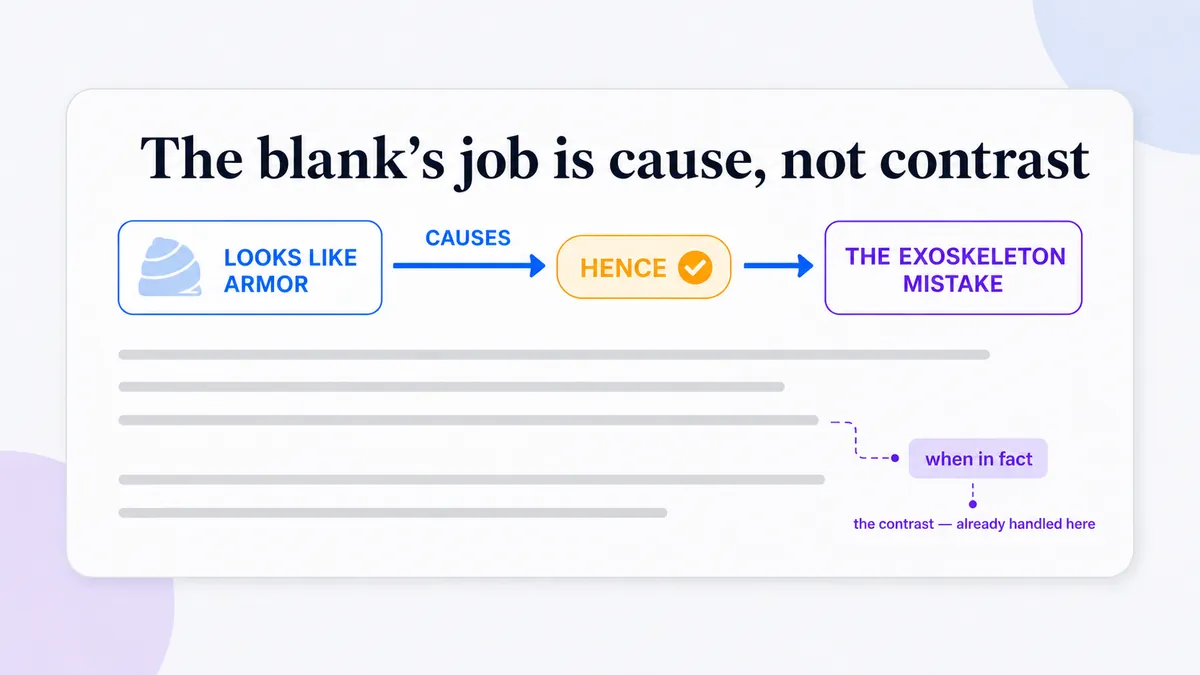
Figure out the blank’s job before you shop for words. The blank connects two ideas: the shell looks external, and people incorrectly assume it’s an exoskeleton. The real relationship between those two isn’t a clash — the look is the reason for the mistake. Because it looks like armor, people file it wrong. Cause and effect. Hence.
But there is a contrast in the sentence — and the sentence already handles it, with “when in fact,” one clause later, where it belongs. The test writers planted a real contrast right after the blank, knowing you’d feel it and reach early. Add choice A — the softer version of the same trap — and 67% of students answered a job the blank was never given.
What the data says
53% pick the wrong answer the question was built around; 29% find the right one. The trap is nearly twice as popular as the right answer.
28 vs 29 seconds. Wrong answers are not rushed answers. The instinct executes perfectly — on the wrong task.
About 7 in 10 hard Reading & Writing questions can’t be answered without real understanding (the parent article’s finding). This question shows how that’s enforced: three plain lines, no big words — and the only way through is the logic.
This is why a score can park at 650 while the student is being careful. The miss doesn’t feel like a trap. It feels like “I was sure of that one.” The most dangerous misses on hard questions are the confident ones.
The skill, named
This question tests one ability: name the blank’s job before you evaluate a single choice.
Every transition blank has a job — connect two specific ideas in one specific way. Cause, contrast, example, addition. The students who get this question right aren’t better at vocabulary, and they aren’t slower or more careful. They simply decide what the relationship is before the answer choices get a vote.
That’s reading for logic instead of shape. No pattern drill builds it, because patterns are exactly what it replaces. And it’s the skill your college reading will assume from day one — a lecture, a textbook, a source you have to evaluate. The SAT is just the first place it gets measured.
Run this every time
Name the two ideas the blank sits between — in your own words.
Commit to the relationship before you look at the choices. Cause? Contrast? Example? Decide first, so the choices can’t decide for you.
Check that a nearby signal isn’t already doing the job. “When in fact” had the contrast covered. A relationship that’s already expressed is never the blank’s job.
Tonight, pull three hard transition questions from your practice set. Cover the choices, write the relationship in your own words, then uncover and answer. Anywhere your written relationship and your final answer disagree, you’ve caught the shortcut habit in the act. That catch is the breakthrough.
A note on sources and figures
Question text: official College Board digital SAT item, reproduced for educational commentary and analysis, attributed to College Board.
Prism Learning platform analysis (2026): accuracy 34% (50 attempts); choice distribution A 14% / B 53% / C 4% / D 29%; median 28s correct / 29s incorrect; the 7-in-10 must-understand rate for hard R&W — from our 2,845-question analysis of official digital SAT questions with real student performance. Prism’s findings, not College Board figures.
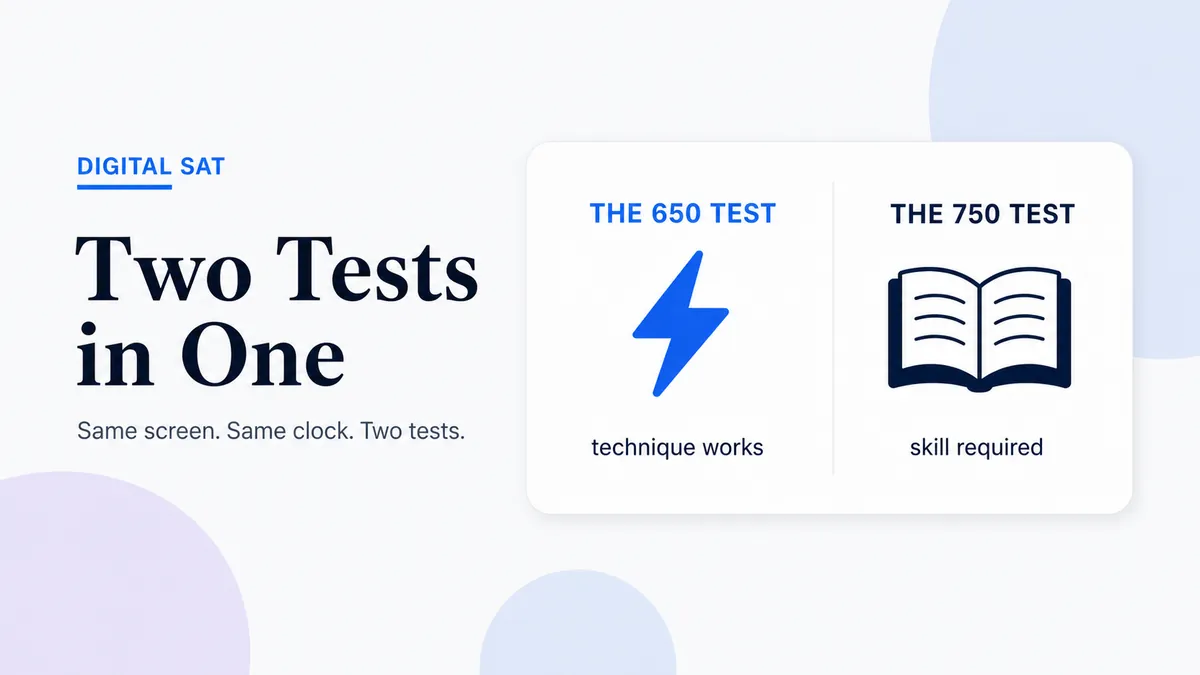
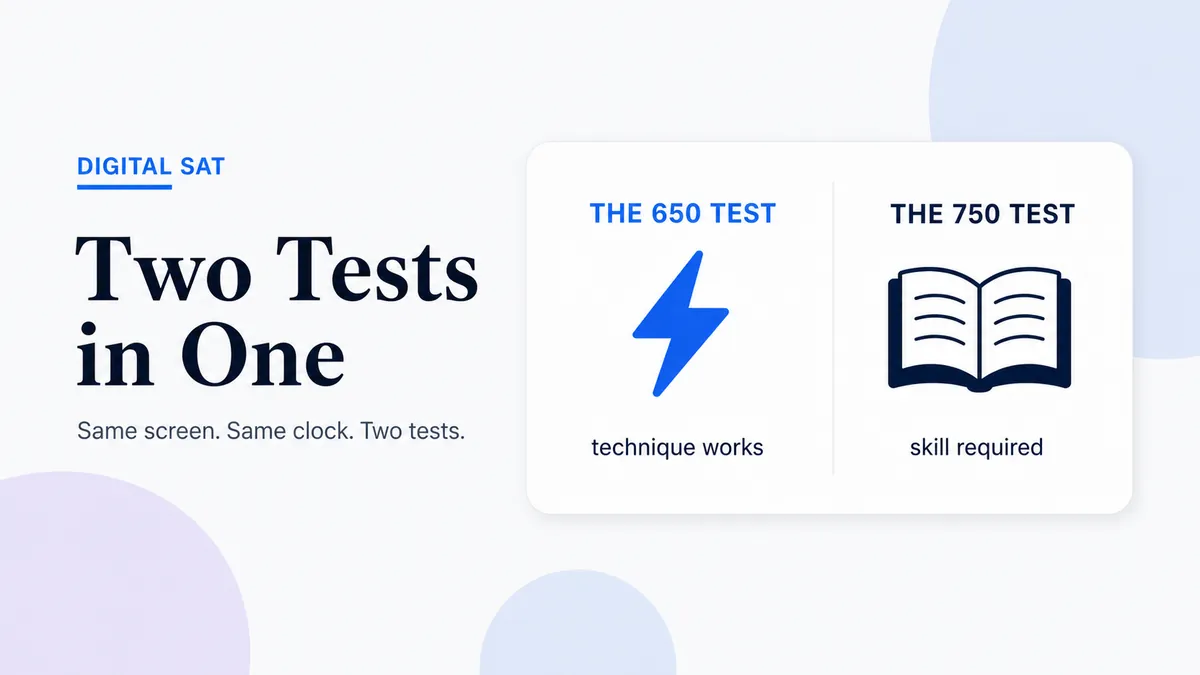
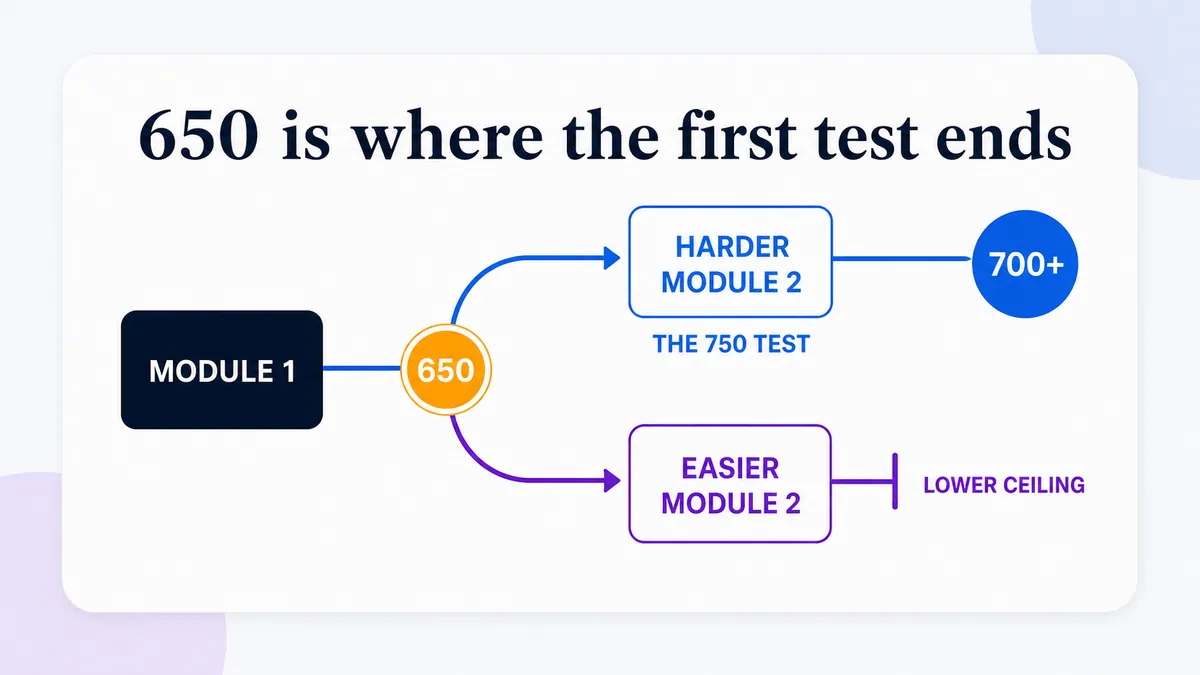
The short answer: The SAT is really two tests in one. The first test is made of easy and medium questions, and it can be beaten with technique — patterns, elimination, plugging in answer choices, calculator routines. Our analysis of 2,845 real digital SAT questions shows that nearly all easy Reading & Writing questions and about 3 in 4 easy Math questions can be answered without the skill they claim to test. The second test is made of hard questions, and it’s built the opposite way: roughly 3 in 4 hard questions in both sections cannot be answered without genuine skill — and many of them are designed so that technique picks a specific wrong answer. Because of the SAT’s adaptive module structure, the first test ends and the second test begins right around 650. If your score is stuck there, you haven’t hit your ceiling. You’ve passed the first test — and you’re taking the second test with the first test’s methods.
I want to share the single most useful thing our research has ever shown me about the SAT. It’s not a strategy. It’s not a question type. It is this: the test you take on your way to 650 and the test you take after 650 are not the same test. They look identical — same screen, same sections, same clock. But they check two completely different things. And they respond to two completely different kinds of preparation.
I know that might be hard to absorb. So you don’t have to take my word for it. I’m going to show you both tests — two real SAT questions, and the data from all 2,845.
The 650 test: watch a shortcut do all the work
Here’s what we did. We took 2,845 real digital SAT questions — 1,465 Math and 1,380 Reading & Writing — and on every single one, we asked one simple thing: can a student get this right without the skill it claims to test?
On easy questions, the answer is overwhelmingly yes:
Reading & Writing: fewer than 1 in 25 easy questions truly require you to understand the passage. Everything else can be answered with something cheaper — a grammar rule, reading just around the blank, elimination.
Math: about 77% of easy questions can be answered without the idea being tested.
Let me make that concrete. Here’s a real easy Math question:
Which of the following is a solution to the equation 2x2−4=x2?
A) 1 B) 2 C) 3 D) 4
— Official College Board digital SAT question.
Watch me solve it without using any algebra idea at all. I’ll just test the choices. Try 1: two times 1 is 2, minus 4 is −2. Is −2 equal to 1? No. Try 2: two times 4 is 8, minus 4 is 4. Is 4 equal to 2 squared? Yes. Done. Answer: B.
Notice what I never did. I never rearranged the equation. I never thought about what x² = 4 means. I didn’t need the concept — I just needed the answer choices and thirty seconds. And the data agrees: on our platform, students take about 22 seconds on this question, and essentially nobody misses it.
This is the test that every “hack” video on the internet is about. And I want to be honest with you here, because this is important: on this test, the shortcuts genuinely work. They’re supposed to. Easy questions are built that way. So let me say something you have probably never heard before: nobody who went from 500 to 650 got lucky. You got good. You got good at the 650 test. That is a real accomplishment.
It’s just not the accomplishment the 700s are asking about.
The 750 test: the questions that check what you actually know
Now run the exact same analysis on hard questions, and the numbers flip:
Reading & Writing: about 7 in 10 hard questions cannot be answered without genuinely understanding the passage. Most of the exceptions are grammar questions, where a punctuation rule happens to be enough.
Math: about 3 in 4 hard questions cannot be answered without the tested concept. No plug-in. No backsolving. No graphing routine. Nothing substitutes.
And here’s the part that should genuinely worry you: the 750 test doesn’t just resist your technique. Many of its questions are built so that the technique picks one specific, confident, wrong answer. On the ant question from the 650 article, reading only around the blank leads you straight to choice A — and A is the most popular answer at 40%, while only 21% of students find the right one. On a hard turtle-shell transition question, the sentence looks like a contrast, and 53% of students pick “However” — the trap — while only 29% pick the correct answer, “Hence.”
On the 750 test, the wrong answer built for shortcut-users gets more votes than the right answer.
Math does the same thing, in its own way. Remember the easy question above — the one you could beat by plugging in the choices? Here’s its hard cousin:
$23y−41x=32−23y21x+23=py+29$
In the given system of equations, p is a constant. If the system has no solution, what is the value of p?
— Official College Board digital SAT question.
Same subject — equations. But look at what changed. There are no answer choices — you type in the answer yourself. Nothing to plug in. Nothing to eliminate. And the calculator doesn’t save you either — you can’t reliably see “no solution” on a graph, and you’d still need the exact value of p. The student who backsolved the easy question in 22 seconds now has no move at all. The only way in is to actually know what “no solution” means: the two lines never meet, so they must be parallel. That’s not an accident. That is the second test doing its job — checking whether the knowledge is there once the shortcuts are taken away.
The data on this question: 36% accuracy, and the students who miss it give up at a median of 96 seconds — half the time of the students who solve it. They aren’t making calculation errors. They never find the way in.
So here’s the picture. One test rewards technique. The other is built to expose it. Same screen. Same clock. Two tests.
Why the switch happens exactly at 650
Now, if the SAT is two tests, here’s the question that makes everything click: why does everyone hit the wall at the same score? Why 650?
Because the switch isn’t gradual — it’s built into the structure. Each section of the digital SAT runs in two modules. Everyone gets a mixed first module, and how you do on it decides which second module you receive: an easier one, or a harder one. (College Board’s test specifications describe this adaptive design.) The easier second module has a ceiling: by our numbers, you can answer every single question on it correctly and your section score still tops out in the high 500s to low 600s. The 700s exist in one place only — inside the harder second module. And that module is filled with exactly the hard questions you just saw.
Now follow a student through this. A good one. Their technique is sharp, so they do well on Module 1. So the test gives them the harder Module 2 — the 750 test. And there, their technique meets question after question built to expose it. They’re good enough to reach the 750 test. They’re not prepared to pass it. So the score lands at 650. Next attempt, 650 again. And again.
That’s the plateau. It’s not a coincidence, and it’s not your ceiling. 650 is simply the score where the first test ends and the second one begins. That’s the whole secret.
Why you never noticed you were taking two tests
Three reasons. None of them your fault.
First — the 650 test is most of what you see. Roughly two out of three questions in the official pool are easy or medium. Most of your drills, most of your practice, most of the confidence you’ve built came from there.
Second — the 650 test kept rewarding you. From 500 to 650, your methods worked and your score climbed. And what’s more convincing than a rising score? The first test spent a year teaching you to trust exactly the methods that the second test is built to expose.
Third — the SAT never announces the switch. Hard questions don’t come labeled. The two modules look identical on screen. The only signal you get is the one you’ve been misreading this whole time: a score that stopped moving. A plateau at 650 is the announcement. It’s the second test telling you it has started, and it wants something different from you.
And this explains the most expensive mistake in SAT prep: preparing for the second test with more first-test training. More drills. More practice tests. More hours with the same methods. Practice reinforces whatever method you bring to it — so all those hours make you faster and more automatic at the wrong test.
The plateau math
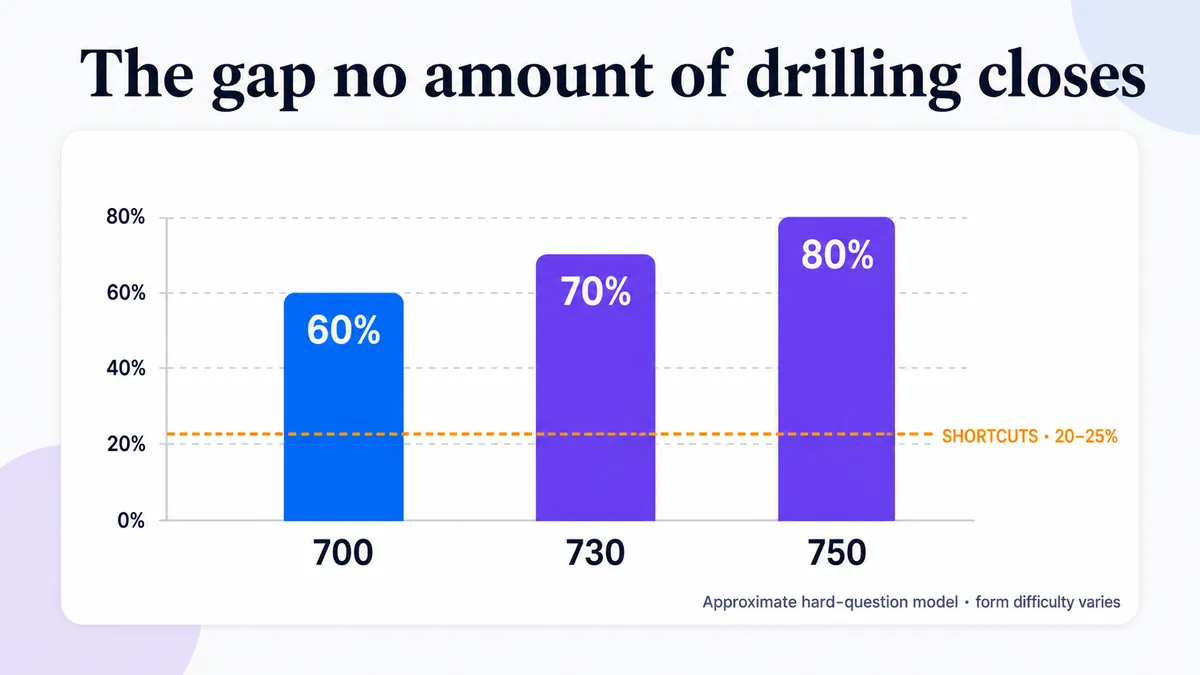
Let me put real numbers on this — they are worth reading slowly. (These are our numbers — exact scaled scores shift from form to form, so treat this as the direction, not a promise.) Inside the harder second module, your score comes down almost entirely to one thing: hard-question accuracy.
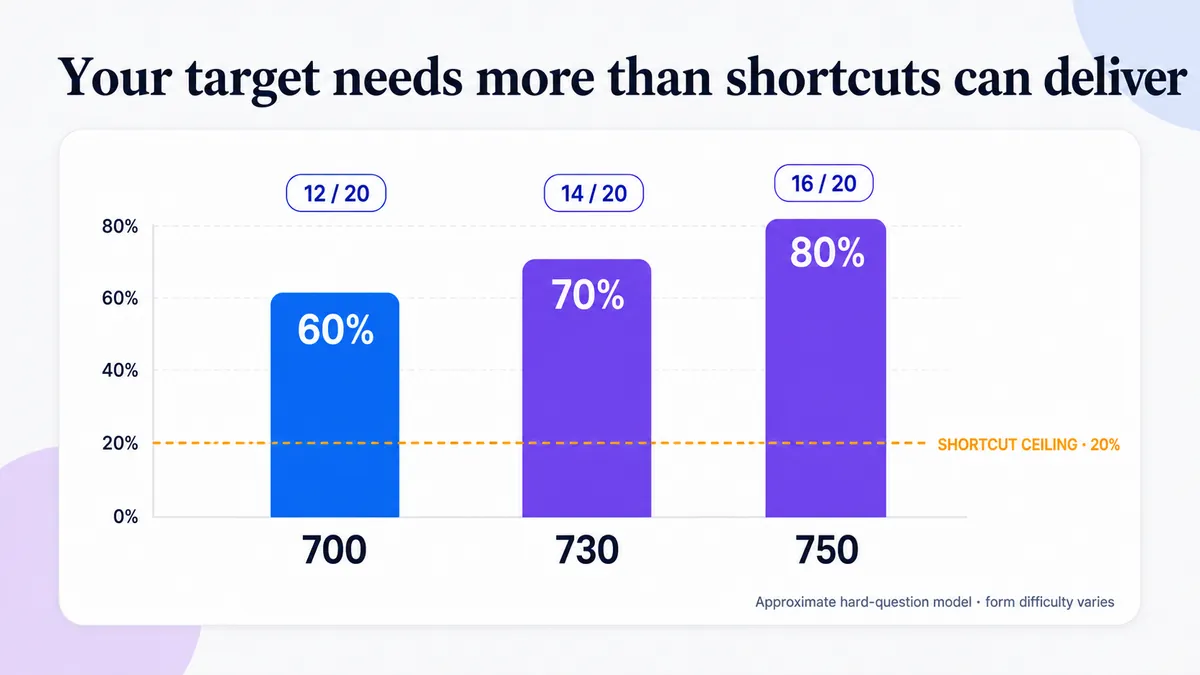
To score 700, you need roughly 60% accuracy on hard questions.
To score 750, you need roughly 80%.
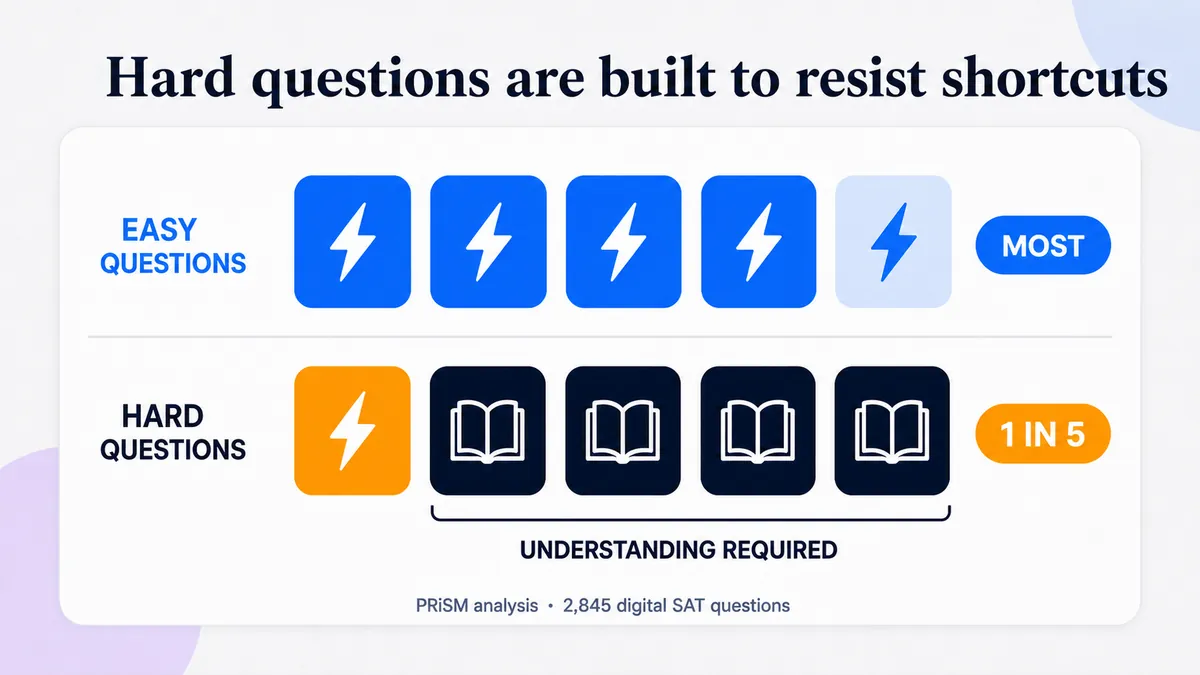
And shortcuts — the entire toolkit of the 650 test — work on only about 20–25% of hard questions. The rest are shortcut-proof by design.
Look at that gap. You need 60, 70, 80 percent. Your method delivers 20-something. That gap is your plateau — not as a feeling, as arithmetic. And no amount of extra practice with the same methods changes that equation. The only thing that closes the gap is the thing the 750 test actually measures.
What the 750 test measures — and how to prepare for it
Three skills. Just three — and every one of them can be trained:
Read something dense and follow its actual logic — not its surface pattern. That’s the skill that picks “Hence” while 53% of the room picks “However.”
Connect a condition to what it implies. That’s the skill that turns “no solution” into “the lines are parallel” before any algebra starts.
Choose your method deliberately — instead of reaching for the same favorite tool every time.
Notice what’s not on that list: speed tricks, elimination rules, memorized templates. The 750 test was built precisely so those don’t carry over.
Preparing for it looks different, and it should feel different — slower at first. On every hard practice question: read the whole thing. Say what it’s actually testing before you solve. Pick your method on purpose. And when you miss, figure out which of the three skills failed — not which trick you forgot. I walk through exactly this, question by question, in the companion articles in this series.
And here’s the part I absolutely love. The 650 test’s skills expire the day you’re done with the SAT. The 750 test’s skills are the exact ones college demands in your first semester — reading dense material for real meaning, reasoning from conditions, judging your approach. So the second test isn’t an obstacle between you and your score. It’s a preview of the student you’re about to become. Prepare for that, and the score comes along with you.
So — tonight. Pull up your last practice test and sort your misses into two piles. Pile one: 650-test misses — easy and medium questions, slips, rushing, careless errors. Pile two: 750-test misses — hard questions where your method never had a way to reach the answer. Count both piles. If pile two is bigger — and at 650, it almost always is — you now know exactly what your next month of prep should look like. Not more of the test you’ve already passed. The other one.
A note on sources and figures
College Board / digital SAT structure (two adaptive modules per section; Module 1 performance routing; harder Module 2 required for top scores; easy/medium/hard difficulty labels) is drawn from College Board’s published digital SAT specifications and scoring documentation.
Prism Learning platform analysis (2026): the 2,845-question dataset (1,465 Math + 1,380 Reading & Writing — every official question with real student performance data available to us); the without-the-skill rates by difficulty (R&W: ~96% easy vs ~32% hard; Math: ~77% easy vs ~25% hard); the easy/medium share of the pool (~2 in 3); the easier-Module-2 score ceiling (high 500s–low 600s); the score→accuracy model (60% for 700, 80% for 750 — directional, not a guarantee); and per-question statistics (backsolving question: 100% accuracy across 23 attempts, median 22s; ant question 40% trap vs 21% correct; turtle transition 34% accuracy, 53% “However” vs 29% “Hence”; no-solution system 36.2% accuracy, median 96s incorrect / 168s correct). These are Prism’s own findings, not College Board figures, and reflect our platform’s population.
Question text: both questions shown are official College Board digital SAT items, reproduced for educational commentary and analysis, and attributed to College Board. The ant, turtle, and no-solution questions are worked in full in the companion articles.
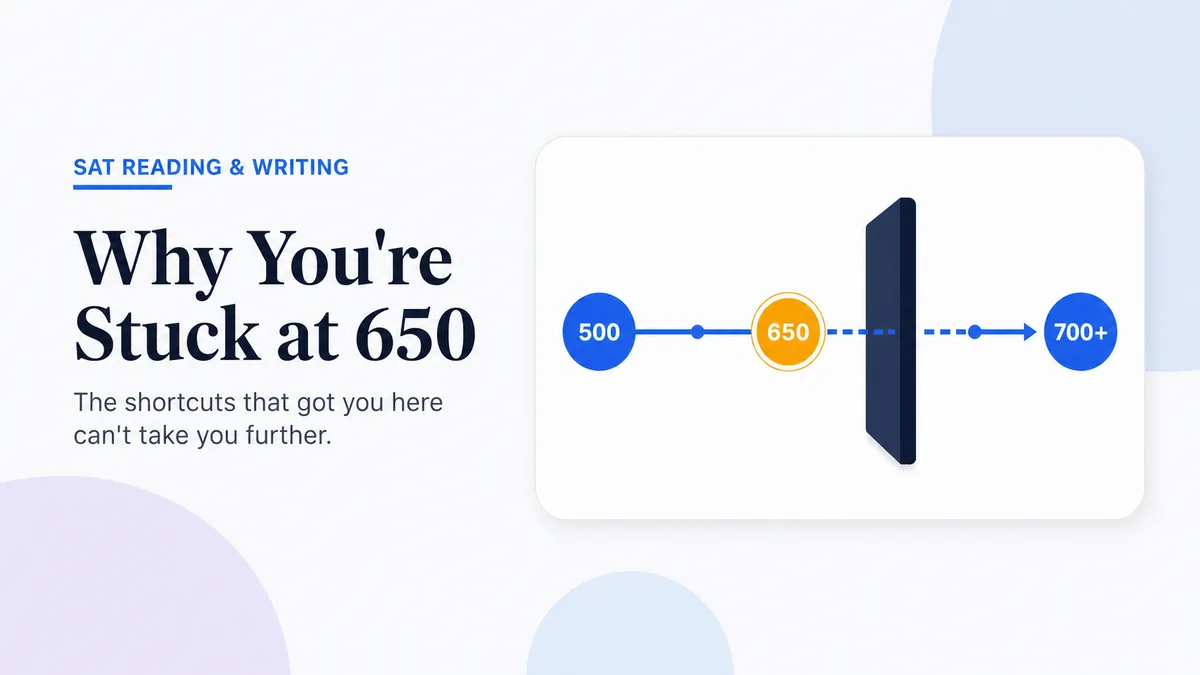
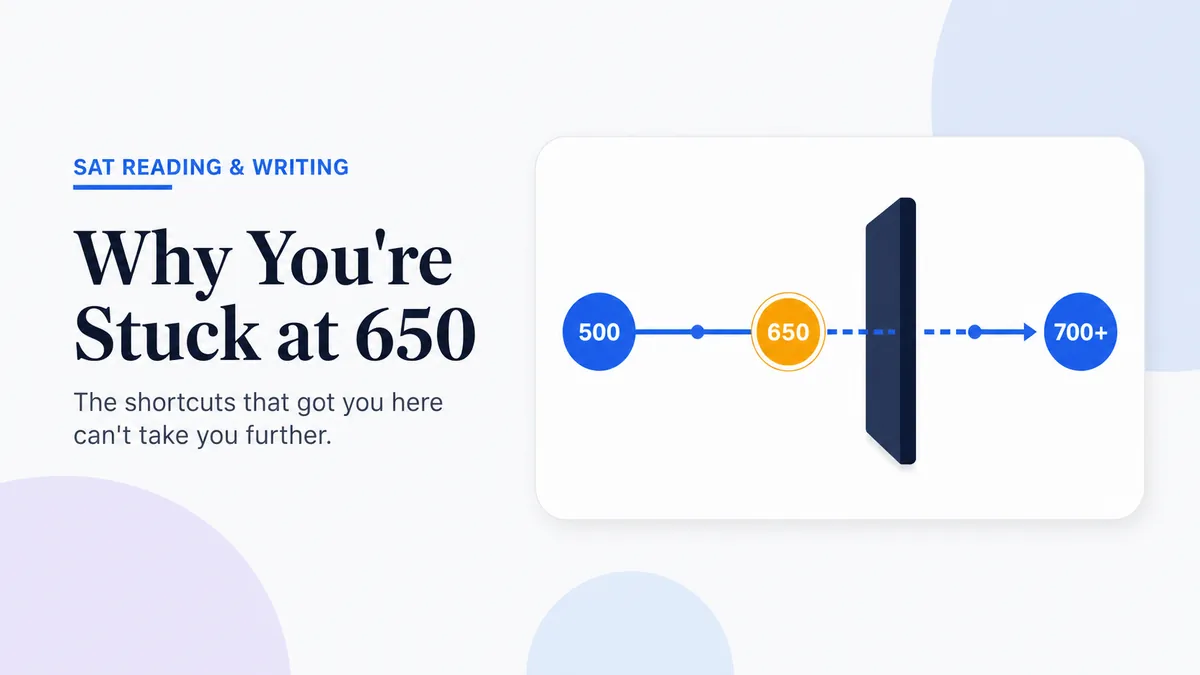
The short answer: You’re not stuck at 650 because of your intelligence, your effort, or your vocabulary. You’re stuck because the very techniques that took you from 500 to 650 stop working on hard questions. We analyzed 2,845 real digital SAT questions, and only about 1 in 5 hard questions can be solved with a shortcut. To break 700, you need 60–80% accuracy on hard questions — and no shortcut strategy gets you there, no matter how much you practice. The fix isn’t a better hack. It’s a different skill: reading for meaning.
If you’ve gone from the 500s up to the mid-600s and then just stopped moving, this one’s for you. You’ve probably taken more practice tests, done more drills, put in more hours — and watched your score sit right there at 640, 650, 660. It’s frustrating. And it makes you start to wonder: maybe this is just my ceiling.
It’s not. And that’s the whole point of what I want to show you. Your plateau isn’t about your ability. It’s a signal that one specific method has hit its limit. And you don’t have to take my word for it — I’m going to take two real SAT questions and prove it to you, and then I’ll show you the data underneath it.
Why 650, and not some other number?
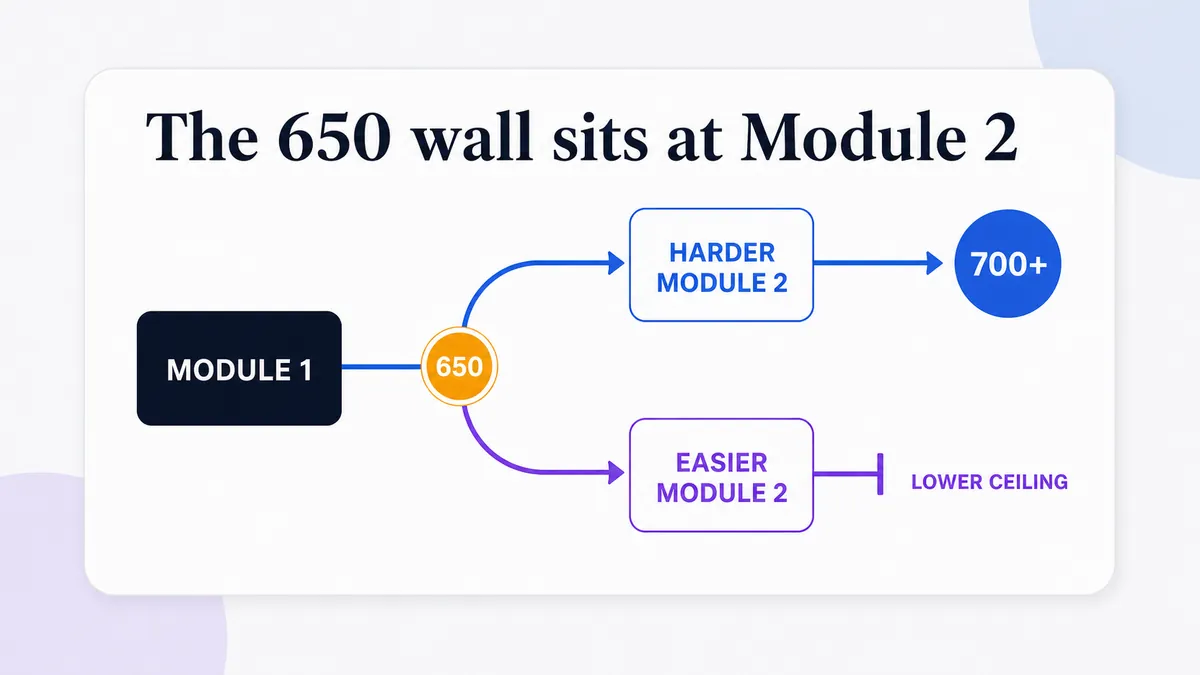
The 650 wall isn’t random. It sits exactly where the digital SAT changes the game on you.
The Reading & Writing section is adaptive. Two modules, 27 questions each — 54 questions, 64 minutes — delivered through College Board’s Bluebook app. Module 1 is a mix of easy, medium, and hard questions. And here’s the thing: how you do on Module 1 decides which Module 2 you get. An easier one, or a harder one. (College Board’s own specifications lay out this multistage adaptive design.)
Why does that matter? Because the easier Module 2 has a ceiling. Even if you get every single question on it right, your section score caps out somewhere in the high 500s to low 600s. To score in the 700s, you have to earn the hard Module 2 — and then you have to perform on it. That’s why so many students pile up right around 650. Their method is good enough to reach the hard module. It’s just not good enough to convert it. They get to the door, and they can’t walk through.
So the real question isn’t “why can’t I get past 650?” It’s “why can’t I get the hard questions right once I’m there?” And the answer, every time, is the method.
The 4 shortcuts that got you here
Let me be specific about what “the method” actually is. These are the four techniques almost every stuck-at-650 student is using. You may never have named them, but you are almost certainly using them:
Read only the first and last sentence. The passage is long, so you skim the opening and the closing line and figure you’ve got the gist.
Read only around the blank. There’s a blank — so why read everything above and below it? You read right before and right after, grab just enough context, and answer.
Eliminate by pattern. A lot of answer choices follow patterns — especially on grammar and transition questions — so you knock out options before you’ve even read the passage.
Keyword-match the question to the choices. You decide a choice can’t be right (or must be right) based on a word in the question, without reading the passage at all.
I want to be clear: none of this is cheating. These are smart, efficient techniques, and they genuinely work — up to a point. They’re exactly what got you from 500 to 650. The problem is they were never a comprehension strategy. They’re a pattern-matching strategy. And the SAT knows it.
Let me show you them working. Then let me show you them failing.
Where the shortcuts work: an easy question
Here’s the question. Take 10–15 seconds and try it yourself before you read on.
Due to their often strange images, highly experimental syntax, and opaque subject matter, many of John Ashbery’s poems can be quite difficult to ______ and thus are the object of heated debate among scholars.
Which choice completes the text with the most logical and precise word or phrase?
A) delegate B) compose C) interpret D) renounce
— Official College Board digital SAT question.
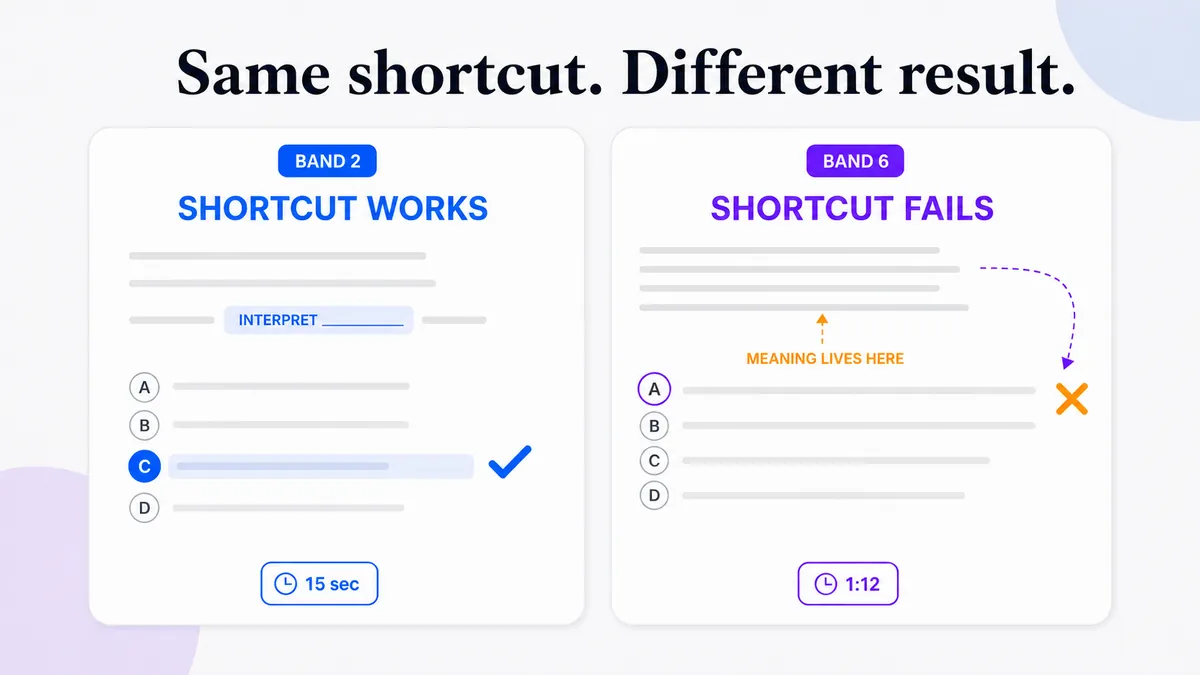
Now watch how I solve it. I’m not going to read the whole passage. There’s a blank, so I read right around it: “difficult to ______ … and thus are the object of heated debate.” Let me run the choices. Delegate? You don’t delegate poems. Compose? These poems already exist — you don’t compose something that’s already written. Renounce? Makes no sense here. Interpret? Yes — poems that are hard to interpret would absolutely be the object of debate. Answer: C.
And notice — I never read the part about “strange images” or “experimental syntax.” Didn’t need it. I read before and after the blank, eliminated as I went, and picked the one that made sense. Ten, fifteen seconds, done.
That’s not just me. On our platform, students get this one right about 85% of the time, in about 15 seconds. On College Board’s difficulty scale it’s a Band 2 question — easy. And that’s the whole point: easy questions are hackable by design. That’s exactly why the shortcut carried you all the way to 650.
(Quick note on the scale: College Board rates every question from 1 to 7 — Bands 1–3 are easy, 4–5 medium, 6–7 hard. You only ever see the broad easy/medium/hard label, but the band underneath is what drives which questions you get and how they’re weighted.)
Now take that exact same method and point it at a hard question.
Where the shortcuts fail: the ant question
Here’s the next one. I’m going to show you only the sentence with the blank — nothing above it — because that’s exactly what a student using the shortcut reads. The sentence with the blank, and nothing else:
By contrast, the researchers observed that uninfected workers in parasitized colonies have shortened lifespans, most likely because the ______
— Official College Board digital SAT question.
So: uninfected worker ants are dying early. Why? Let’s look at the choices — and I’ll tell you the share of our students who picked each one:
A) uninfected workers are at high risk for direct exposure to A. brevis in the course of providing social care to the infected workers in the nest. — 40%
B) need to compensate for reduced contributions within the colony while also caring for infected workers is burdensome to the uninfected workers. — 21%
C) high level of activity maintained by the uninfected workers makes them better able than infected workers to quickly disperse when the nest is attacked by a predator. — 25%
D) average lifespan of T. nylanderi worker ants in colonies without parasitic activity typically falls well below three years, the range covered by the study. — 14%
Read only around the blank, and choice A looks right, doesn’t it? Healthy ants taking care of sick ants would be more exposed to the infection. It’s clean, it’s intuitive. And it’s wrong.
The single most popular answer — 40% of students — is the wrong one. And it’s the shortcut that walks them straight into it. Only 21% get it right. So if you picked A, you’re not careless and you’re not slow. You’re in the biggest group in the room, and you got there using the exact method that worked so well on the poem. For the record: this is a Band 6 question, and our students spend about 1 minute 12 seconds on it, versus 15 seconds on the poem — a gap that will matter again in the plateau math below.
Now let me solve it the right way — by actually reading the passage. Here’s everything the shortcut told you to skip:
In a three-year study of parasitic infections by Anomotaenia brevis tapeworms in Temnothorax nylanderi ants, entomologist Susanne Foitzik and colleagues found something unexpected: rather than reducing its host’s fitness, as is typical of parasites, A. brevis greatly extends the lifespan of a T. nylanderi worker ant and seems to halt the effects of aging. Furthermore, those infected receive special treatment, ceasing their share of labor to sustain the colony and remaining in the nest as uninfected workers feed, groom, and transport them. By contrast, the researchers observed that uninfected workers in parasitized colonies have shortened lifespans, most likely because the ______
— Official College Board digital SAT question.
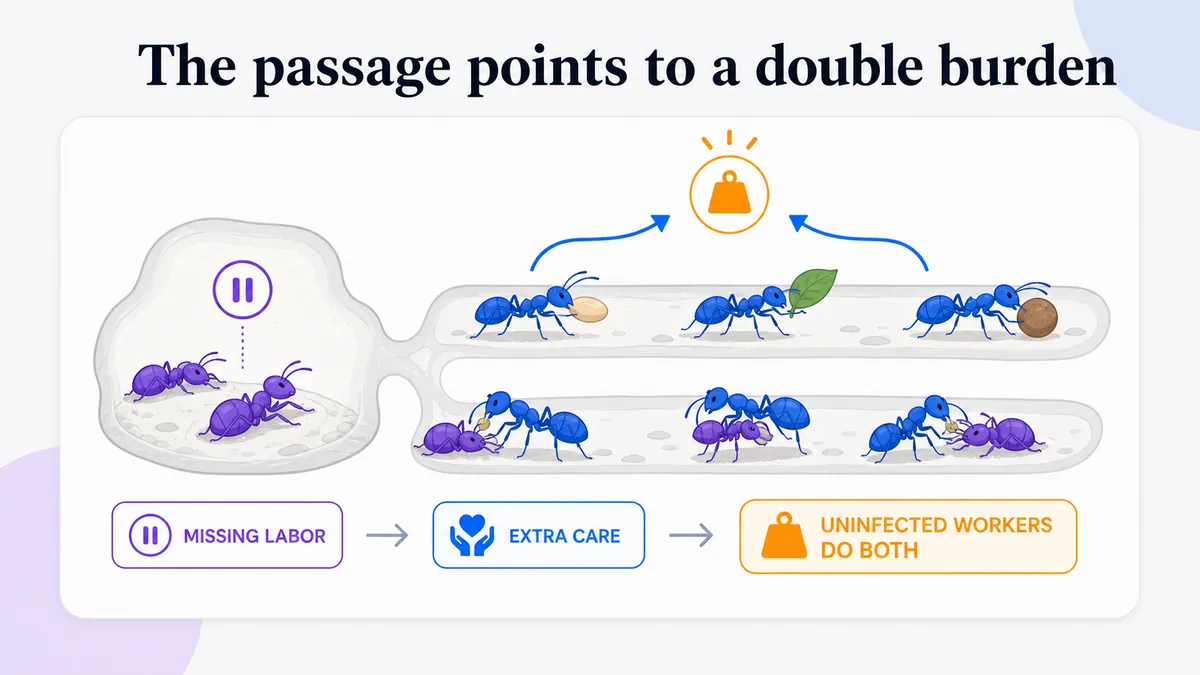
Read that, and the “by contrast” sentence completely changes. Look at what the passage tells you that the blank sentence alone never could: the infected ants have stopped doing their share of the work, and it’s the uninfected ants who are feeding them, grooming them, carrying them. So why are the uninfected workers dying early? Because they’re doing double duty — covering the work the infected ants dropped, and taking care of the infected ants on top of it. That’s choice B. And once you actually understand the passage, B isn’t a tough call. It’s a slam dunk.
Now go back and look at A. It’s not random — part of it is even true; the uninfected workers really do provide care. But the passage never says one word about them being at higher risk of direct exposure. That’s a detail your brain filled in to make the shortcut feel complete. The passage hands you the double-burden idea in B, and says nothing about exposure in A. The only way to see that is to read for meaning. The shortcut can’t get you there — because everything you needed was sitting in the part of the passage it told you to skip.
The hackability study: 2,845 real questions
Now, you might be wondering — did I just cherry-pick that question? Fair. So let me show you the bigger picture.
We took 2,845 real digital SAT questions — 1,465 Math and 1,380 Reading & Writing, every official question we have real student performance data on — and on every single one we asked one simple thing:
Can you get this right without actually understanding the whole passage?
We called it hackability. And here’s what we found:
Easy questions: you can hack almost all of them.
Hard questions: almost none — only about 1 in 5.
Now flip that around, because the flipped version is the most useful idea in this whole article:
If a question won’t let you take a shortcut, it’s almost certainly a hard one.
The SAT is basically using hack-resistance as a difficulty filter. And that’s not a figure of speech. A big part of what makes a hard question hard is that skimming and pattern-matching lead you to an answer that feels right and isn’t. The ant question isn’t the exception — it’s the rule. And that’s exactly why “just do more practice” doesn’t fix you: you’re drilling a method that, by design, only works on the 1-in-5 hard questions that happen to be hackable.
The plateau math (and how to break it)
Let me put real numbers on this, because this is where the plateau stops being a feeling and becomes math.
To score above 650, you have to earn the hard Module 2. And when we look at what a hard Module 2 actually contains, out of its 27 questions, about 20 are hard. So your score now comes down almost entirely to how many of those ~20 hard questions you get right.
Here’s the map. (These are our numbers — exact scaled scores shift from form to form, so treat this as the direction, not a promise.)
Target R&W score
Hard questions you need right (of ~20)
Most you can miss
Accuracy on hard questions
700
12
8
~60%
730
14
6
~70%
750
16
4
~80%
Now bring back the hackability number. Only about 20% of hard questions are hackable. So if you keep leaning on shortcuts, you top out at roughly 20% accuracy on the exact questions that decide your score.
Look at the gap:
To hit 700, you need 60%. Shortcuts give you about 20%.
To hit 730, you need 70%. Shortcuts give you about 20%.
To hit 750, you need 80%. Shortcuts give you about 20%.
That gap — that’s your plateau. It’s not your intelligence, it’s not your effort, it’s not your vocabulary. It’s the mismatch between the accuracy your target needs and the ceiling your method allows. And this is the part that matters most: more practice with the same shortcuts cannot close it. That 20% doesn’t move because you did more drills. The math is fixed. Doing more of the same just buys you more 650s.
Why more practice — and more tutoring — hasn’t worked
If you’re a parent watching the score stall even with a tutor and more and more hours, this is your explanation. The money isn’t wasted because your child isn’t trying, and it isn’t wasted because the tutor is bad. It’s aimed at the wrong thing. Practice reinforces whatever method you bring to it. If the method is shortcut-based, more reps just make the shortcuts faster and more automatic — which is the last thing you want on hard questions. You get better and better at reaching a ceiling you can’t cross.
So the question isn’t “how many more hours?” It’s “are those hours building comprehension, or drilling shortcuts?” That one distinction is usually the whole reason one student breaks through and another spends another six months at 650.
What actually breaks the plateau
Going from a good score to a great score was never about finding more hacks, or better hacks. It’s a completely different skill: reading the passage and truly understanding what it says. Thinking about it, not scanning it. When you understand the ant passage, you don’t have to cleverly eliminate your way to B — it just jumps out at you. That’s what comprehension buys you: on hard questions, the right answer stops being a guess and starts being obvious.
And here’s the part I absolutely love. On your way to a 750+ Reading & Writing score, you’re not learning some test trick that dies the day you close Bluebook. You’re building a comprehension skill — the ability to read something hard, hold it in your head, and understand what it’s really saying. That skill goes with you to college. It goes with you into your career. It’s one of the very few things you study for the SAT that you actually keep for the rest of your life.
So here’s where that leaves you. Your 650 was never a ceiling on what you’re capable of. It was the limit of a method that quietly stopped fitting the questions that matter most. And honestly, that’s good news hiding inside a frustrating score — because it means you don’t have to become a different person to break 700. You have to change what you do the moment you hit a hard question. Stop hunting for the shortcut. Start reading it for what it actually says.
Learning to do that well — how to read a dense passage under time pressure, how to hold its meaning, how to make the right answer surface on its own the way B did — that’s a craft, and it’s exactly what I’ll walk you through in the next articles in this series. But you can start tonight. The next time a hard question tempts you to skim and pattern-match, don’t. Read it. Understand it. Let the answer come to you. That’s not a trick. That’s the skill that takes you past 650 — and a long way beyond the SAT.
A note on sources and figures
College Board / digital SAT structure (two adaptive modules of 27; 54 questions; 64 minutes; harder Module 2 = higher score ceiling; 200–800 R&W scale; Bluebook delivery; format in effect since Spring 2024) is drawn from College Board’s published digital SAT specifications and scoring documentation.
Prism Learning platform analysis (2026): the 2,845-question dataset (1,465 Math + 1,380 Reading & Writing — every official question with real student performance data available to us), the ~20% hackability rate for hard R&W questions, the per-question statistics (85% accuracy / ~15 seconds on the poem question; 21% accuracy / ~1 min 12 seconds and the 40% / 21% / 25% / 14% answer distribution on the ant question), the ~20-of-27 hard-question composition of a hard Module 2, and the score→accuracy model (60% / 70% / 80% for 700 / 730 / 750). These are Prism’s own findings, not College Board figures. Scaled scores vary by test form; the score→accuracy mapping is directional, not a guarantee.
Difficulty bands: the 1–7 difficulty scale (Bands 1–3 easy, 4–5 medium, 6–7 hard) is College Board’s own question-difficulty scale; the poem question is Band 2 and the ant question is Band 6. Students see only the broad easy/medium/hard grouping in official materials.
Question text: both questions shown are College Board digital SAT items, reproduced here for educational commentary and analysis, and attributed to College Board.
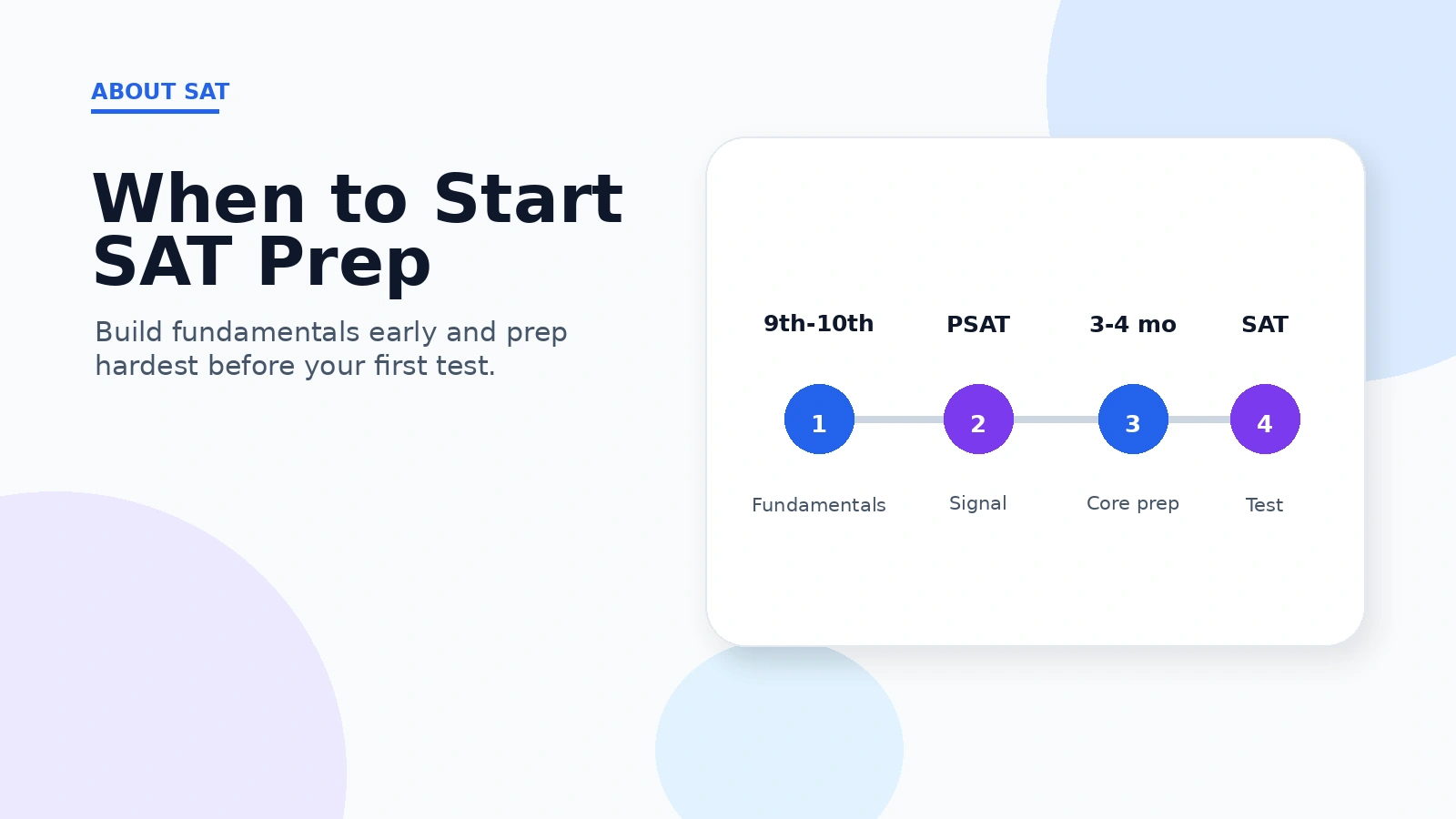
The simplest rule for when to start SAT prep is to begin about three to four months before your first test date, which usually means starting in the fall or winter of junior year for a spring SAT. That window is long enough to cover every content area and take full-length practice tests without burning out. Here is how to time your prep by grade, how many months you really need, and how to line it up with test dates.
When to start SAT prep
The right start date works backward from your first test. Plan for roughly three to four months of steady preparation, a few hours a week, leading into the test. For a March or May SAT in junior year, that means starting around November to January.
Starting earlier than four months out is fine if you spread the work thinly, but very long timelines often lose momentum. Starting much later than three months out tends to compress practice tests and leave content gaps. The sweet spot for most students is a focused three-to-four-month block built around a specific test date.
The ideal SAT prep timeline by grade
Grade
What to do
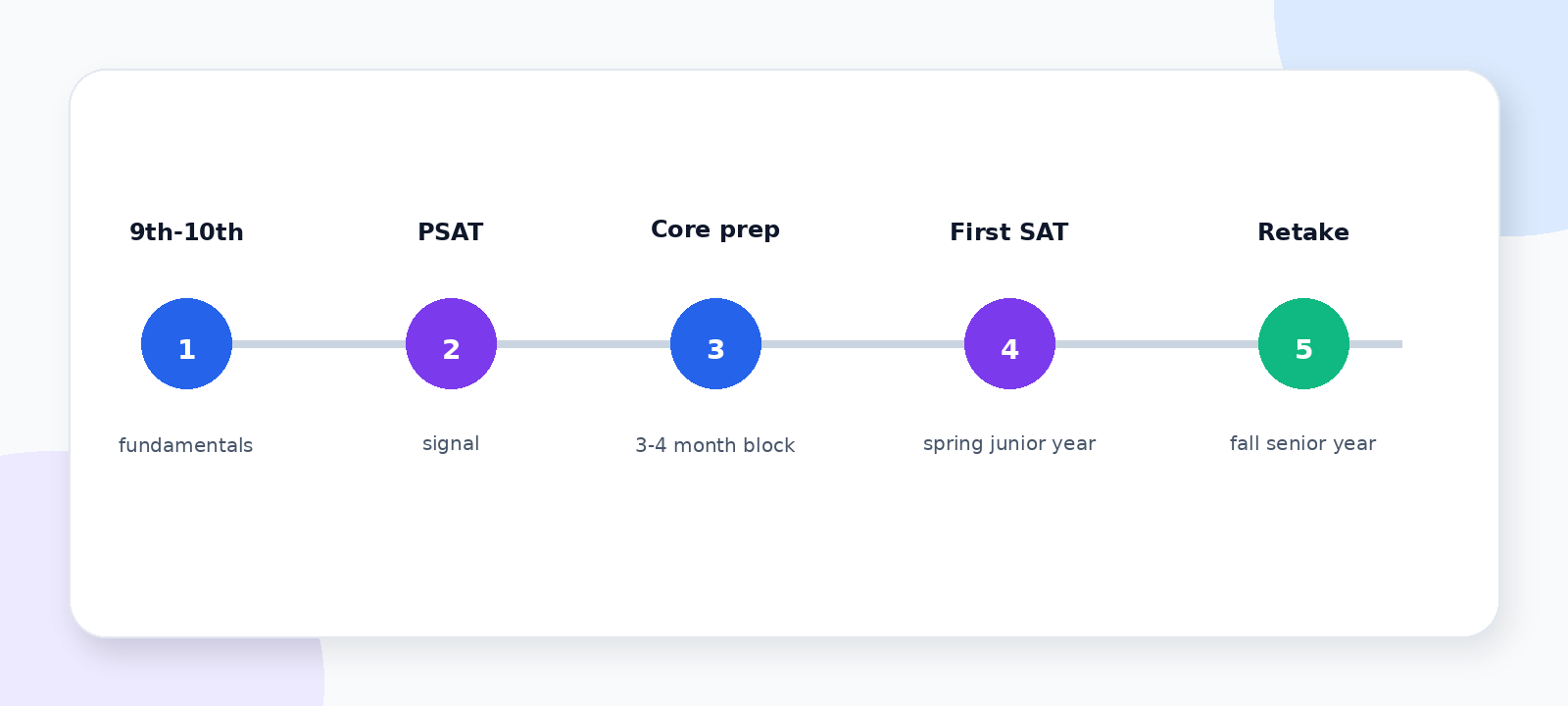
9th-10th grade
Build strong reading and math fundamentals; take the PSAT for a baseline. No formal SAT prep needed yet.
Fall of 11th grade
Take the PSAT; begin light, structured prep with a diagnostic test.
Winter-spring of 11th grade
Core prep block; take your first SAT in March, May, or June.
Summer before 12th grade
Review weak areas from your first score; prep for a retake.
Fall of 12th grade
Retake in August, September, or October if needed, before application deadlines.
Taking your first SAT in junior year is the single most useful timing decision, because it leaves room for a retake while keeping scores ready before senior-fall deadlines.
How many months of SAT prep do you need?
The honest answer depends on the gap between your diagnostic score and your target. A good rule of thumb is that a focused student can target a meaningful score gain over about three to four months of consistent work, but a larger jump naturally takes longer.
Start with a full-length diagnostic to find your baseline and your weakest content domains. Then weight your study time toward those domains and toward the highest-value areas of the test. Our Digital SAT syllabus shows how the eight content domains are weighted so you can prioritize, and our guide to building an SAT study plan turns that into a week-by-week schedule.
Lining up prep with your test date
Choose your test date first, then count backward three to four months to set your start date. Make sure your chosen date leaves room for a retake before any application deadlines, and confirm the schedule on our SAT test dates guide.
If you are applying Early Decision or Early Action, plan so that you finish testing by the early-fall date whose scores will arrive before your deadline, often the October SAT. Registering early also protects your choice of test center, which matters most during the busy fall season.
Frequently asked questions about SAT prep timing
Q: When should I start studying for the SAT? A: About three to four months before your first test date, which for a spring SAT in junior year usually means starting in the fall or winter of 11th grade. That gives you time to cover content and take full practice tests.
Q: What grade should I take the SAT in? A: Most students take it for the first time in the spring of junior year, then retake it in the early fall of senior year if needed. This leaves room to improve while keeping scores ready before deadlines.
Q: How many months of SAT prep do I need? A: Three to four months of consistent work suits most students aiming for a solid improvement. A larger score jump usually takes longer, so start with a diagnostic to gauge the gap.
Q: Is it too early to prep in 9th or 10th grade? A: Formal SAT prep is usually unnecessary that early. Focus on strong reading and math fundamentals and take the PSAT; targeted SAT prep is most effective starting in junior year.
Q: Can I prepare for the SAT in one month? A: It is possible to review and sharpen test strategy in a month, but one month rarely allows enough full-length practice to close large content gaps. If your timeline is short, prioritize your weakest high-value domains.
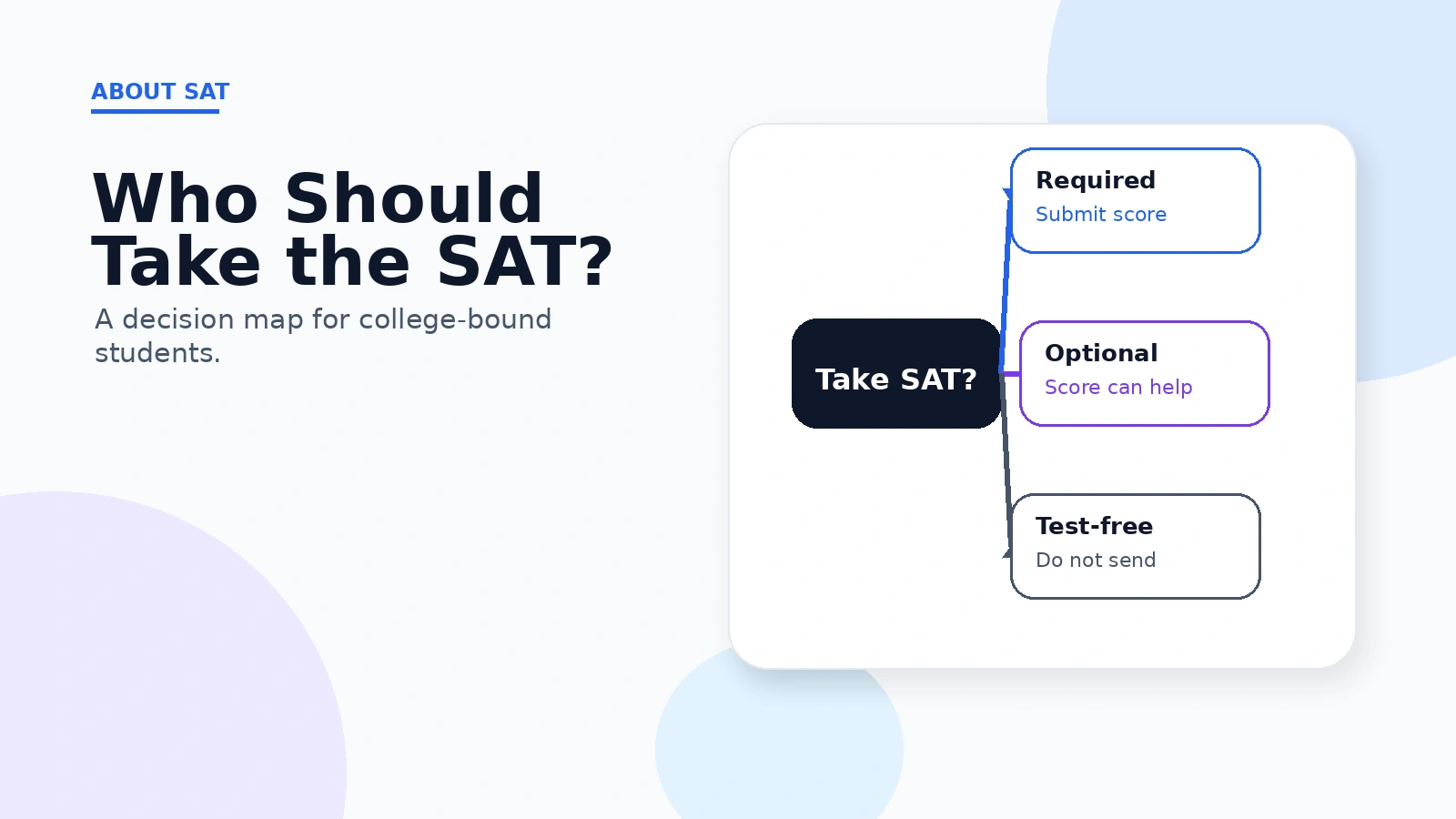
The short answer to who should take the SAT is that most college-bound students still should. As of the 2026-2027 cycle, many of the most selective universities have brought back testing requirements, and even at schools that remain test-optional, roughly 80 to 85 percent of applicants submit scores. The main exceptions are students applying only to test-free schools like the University of California. Here is who needs the SAT, who can skip it, and why scores still matter even when they are optional.
Who should take the SAT in 2026-2027
You should plan to take the SAT if any school on your list requires or recommends testing, if you might pursue merit scholarships, or if a strong score would strengthen an application where your GPA alone might not stand out. For most students building a college list with a mix of selective schools, that covers nearly everyone.
You can reasonably skip the SAT only if every school you are applying to is test-free (meaning it will not consider scores at all) and you are not seeking scholarships that require them. Because policies change and college lists grow, taking the test once keeps your options open.
The test-optional landscape has shifted
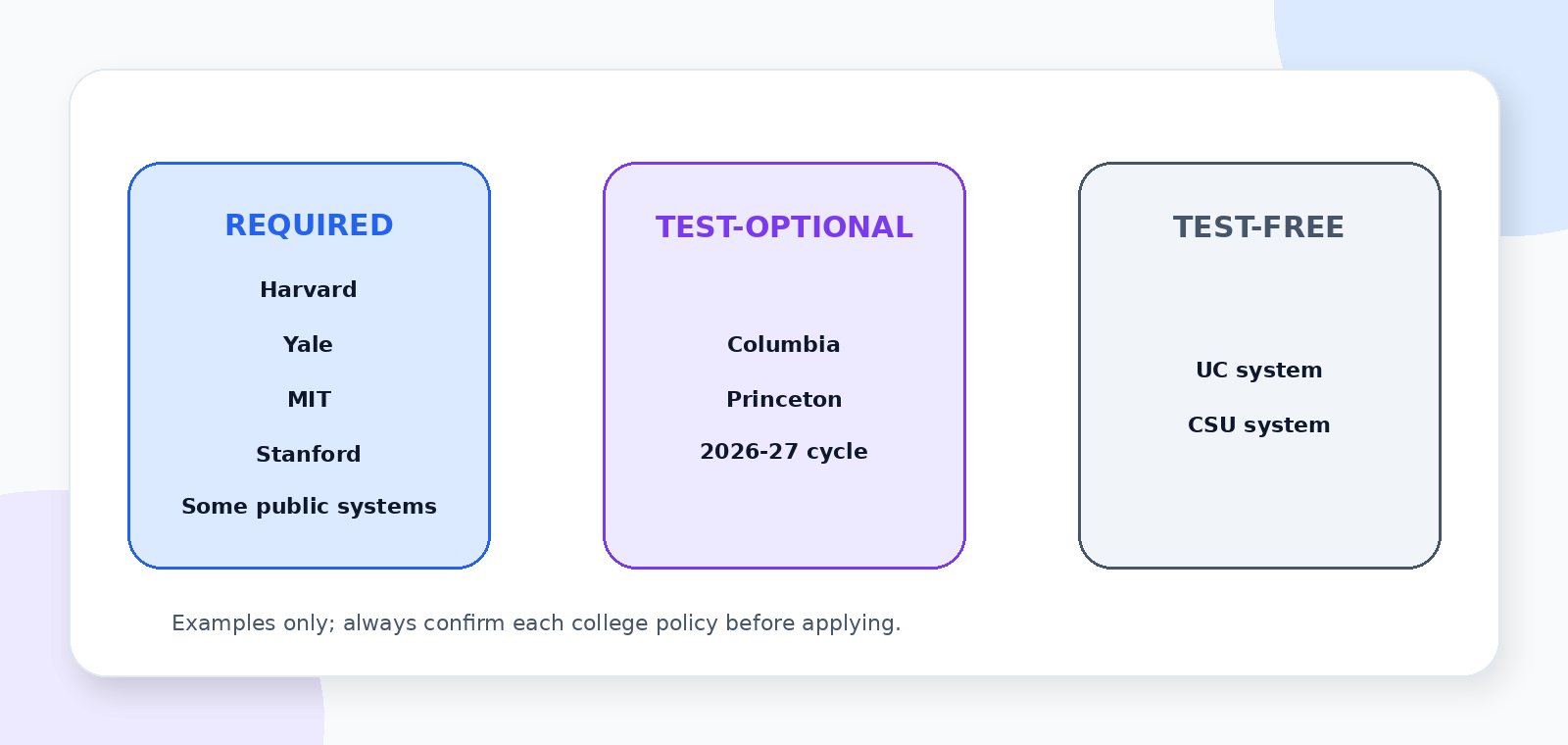
The pandemic-era test-optional wave is receding at the most selective universities. For the 2026-2027 application cycle, six of the eight Ivy League schools require scores: Harvard, Yale (under a test-flexible policy that also accepts AP or IB results), Brown, Dartmouth, Cornell, and the University of Pennsylvania.
Columbia remains the only Ivy with a permanent test-optional policy, and Princeton is test-optional for 2026-2027 before requiring scores starting with the 2027-2028 cycle. Beyond the Ivies, schools such as MIT, Caltech, Stanford, Georgetown, and Johns Hopkins require scores, as do large public systems including Florida, Georgia, the University of Texas at Austin, and Ohio State’s Columbus campus. Several of these reinstated testing after internal research found scores were a strong predictor of college success, particularly for lower-income and first-generation students.
Policies still vary widely and continue to change, so verify the current requirement for every school on your list directly with its admissions office before you decide.
Why scores still help even at test-optional schools
Test-optional does not mean test-blind. At schools that let you choose, a strong score is one more piece of evidence in your favor, and the share of applicants submitting scores has climbed from roughly 55 to 60 percent a few years ago to about 80 to 85 percent today.
Scores can also unlock money. Many colleges, including some that are test-optional for admission, use SAT or ACT scores to award merit-based scholarships and to qualify students for honors programs. A good score can be worth real financial aid even where it is not required to apply.
The practical rule at a test-optional school: submit your score if it is at or above the school’s published middle-50% range, and consider withholding it only if it falls well below. To find your starting point, take a diagnostic and compare it to your target schools’ ranges.
Who can skip the SAT
A small set of schools are test-free (sometimes called test-blind), meaning they will not consider scores even if you send them. The University of California system has been test-free since 2021, and the California State University system followed in 2022, both by policy that is not expected to change.
If your entire list is test-free and no scholarship you want requires a score, you do not need the SAT. Even then, taking it once is low-risk insurance in case you add a school or a scholarship later. To decide between tests, see our comparison of the SAT vs ACT, and to plan your timing, read when to start SAT prep.
Frequently asked questions about who should take the SAT
Q: Do I still need to take the SAT in 2026? A: Most likely yes. Many selective colleges require scores again for the 2026-2027 cycle, and most applicants to test-optional schools submit scores anyway. You can skip it only if every school on your list is test-free and you are not chasing scholarships that need a score.
Q: Which Ivy League schools require the SAT? A: For 2026-2027, Harvard, Yale, Brown, Dartmouth, Cornell, and the University of Pennsylvania require scores. Columbia is permanently test-optional, and Princeton is test-optional for this cycle before requiring scores in 2027-2028. Always confirm with each school.
Q: Should I submit my score to a test-optional school? A: Generally submit it if it is at or above the school’s middle-50% range, and consider withholding it if it falls well below. A score in range can only help, and may also qualify you for merit aid.
Q: Are there schools that will not look at my SAT score at all? A: Yes. Test-free schools such as the University of California and California State University systems do not consider scores in admissions, though some may use them for course placement after you enroll.
Q: Does a good SAT score help with scholarships? A: Often, yes. Many colleges use SAT or ACT scores to award merit scholarships and honors-program eligibility, sometimes even when scores are optional for admission.
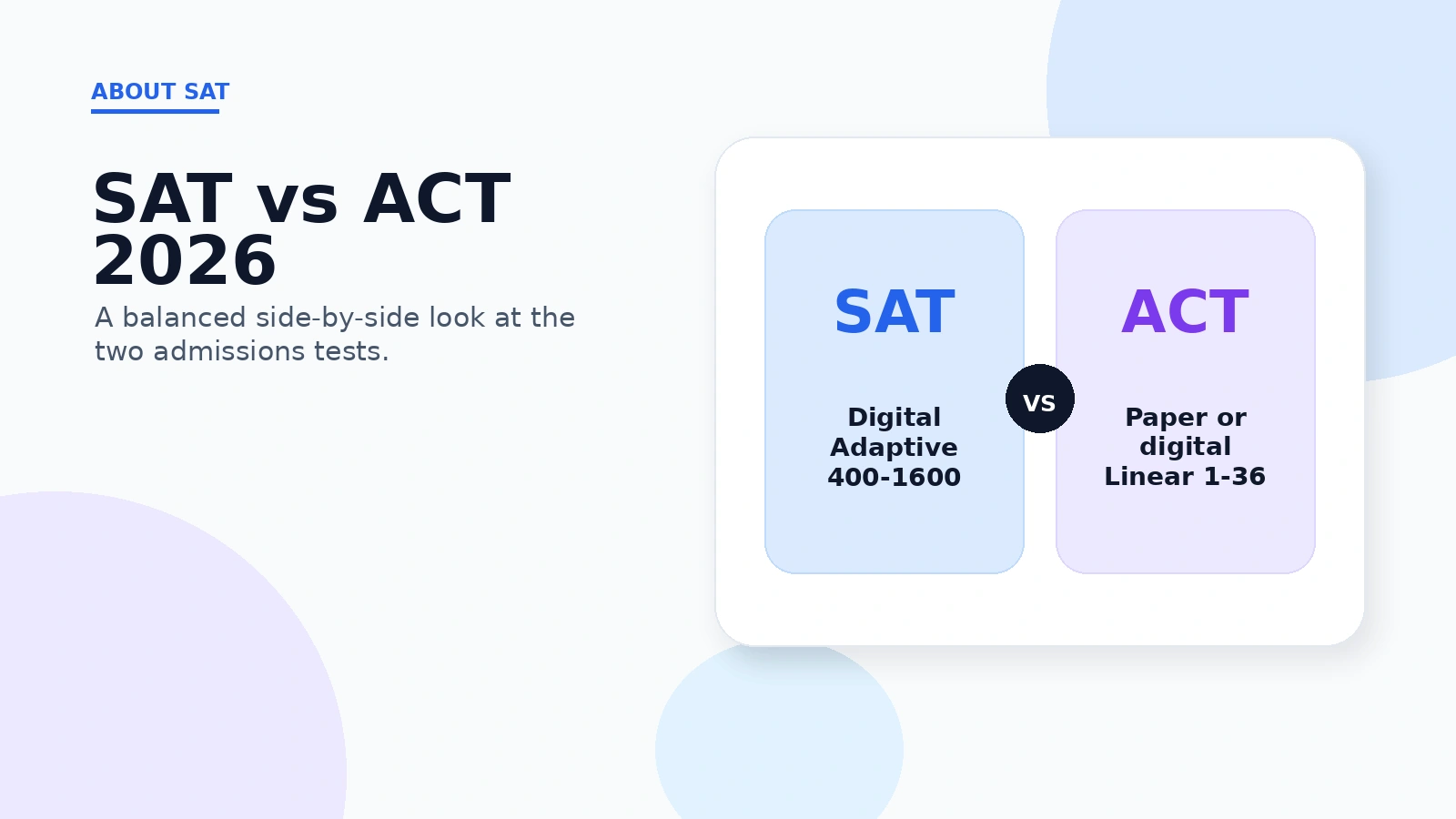
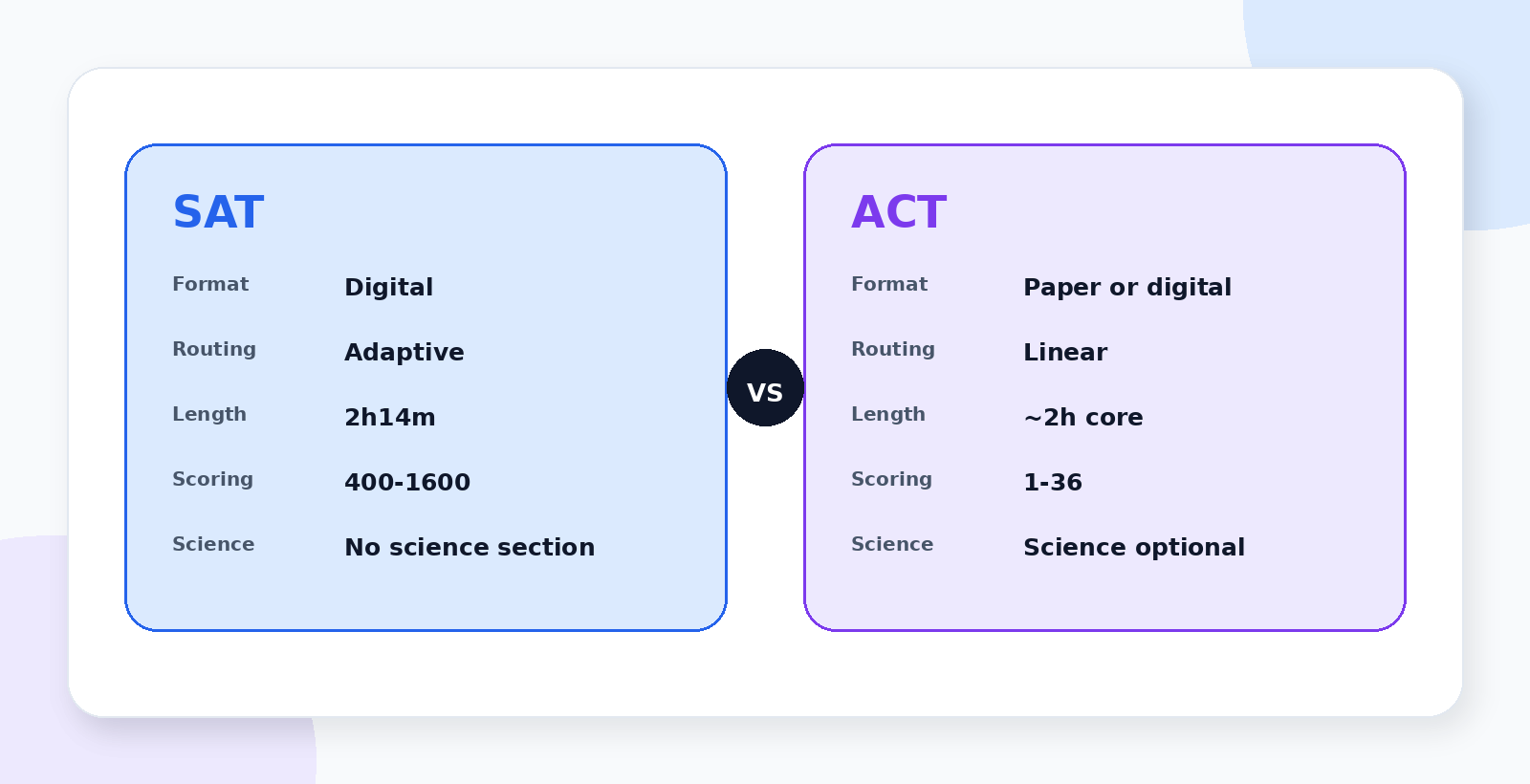
In the SAT vs ACT decision, the biggest 2026 differences are format and structure. The Digital SAT is a fully digital, section-adaptive test of 2 hours 14 minutes scored from 400 to 1600. The Enhanced ACT is a shorter, linear test (paper or digital) with a now-optional Science section, scored from 1 to 36. Most colleges accept either equally, so the right choice usually comes down to which format fits how you think. Here is the full comparison.
SAT vs ACT: the key differences
Both tests changed dramatically in the last two years, so older advice is often out of date. The table below reflects the current 2026 formats.
Feature
Digital SAT
Enhanced ACT
Format
Fully digital, section-adaptive
Paper or digital, linear (not adaptive)
Length
2 hours 14 minutes
About 2 hours core; about 2h40m with Science
Sections
Reading and Writing, Math
English, Math, Reading; Science and Writing optional
Total score
400 to 1600
1 to 36 composite
Science
No separate section
Optional separate section (not in composite)
Calculator
Allowed on all Math (Desmos built in)
Allowed on Math
Scores released
About two weeks
About two to eight weeks
How the Digital SAT works now
The SAT went fully digital in March 2024, and the paper version is gone. It has two sections, Reading and Writing and Math, each split into two modules, for 98 questions in 2 hours and 14 minutes. There is no essay; the optional essay was retired in 2021.
Its defining feature is that it is section-adaptive: your performance on the first module of each section routes you into a harder or easier second module, and the harder path unlocks the top scores. For a full breakdown, see our Digital SAT format guide and the Digital SAT syllabus.
How the Enhanced ACT works now
The ACT rolled out its “Enhanced” format starting in April 2025 for national online tests, September 2025 for all national weekend tests, and spring 2026 for school-day administrations. The core test is now English, Math, and Reading, taking about two hours, down from roughly three hours on the old version.
The headline change is that Science is now optional. The 1 to 36 composite is built only from English, Math, and Reading; if you take Science, it is reported separately and feeds a STEM score, but it does not affect your composite. Writing remains optional too. Unlike the SAT, the ACT is linear, not adaptive, and you can choose paper or digital.
Which test should you take?
Because colleges treat the two tests equally, choose the one you score better on and feel more comfortable taking. A few patterns can guide you:
Consider the SAT if you prefer a fully digital, adaptive test, want a built-in graphing calculator on every math question, and like more time per question.
Consider the ACT if you prefer a linear test you can take on paper, are strong in science reasoning (and want that separate score for STEM programs), or simply pace better on its style of questions.
The most reliable way to decide is to take a timed, full-length practice test of each current format and compare both your scores and how each one felt. At Prism Learning, a diagnostic on each test shows you where you stand and which one gives you the higher ceiling, so you can commit your prep time to a single test with confidence.
Do colleges prefer the SAT or the ACT?
No. Colleges that require or accept testing accept the SAT and the ACT equally and do not favor one. Yale’s “test-flexible” policy even lets applicants meet the requirement with AP or IB scores instead. Whether scores are required at all depends on the school; for that, see our guide on who should take the SAT.
Frequently asked questions about SAT vs ACT
Q: Is the SAT or ACT easier? A: Neither is universally easier. They reward slightly different strengths, the SAT with its adaptive digital format and more time per question, the ACT with its linear structure and optional Science. The best test is the one you score higher on, which a practice test of each will reveal.
Q: Do colleges prefer the SAT or the ACT? A: No. Schools that consider testing accept both equally. Choose the test that suits you, not the one you think colleges want.
Q: Is the ACT Science section still required? A: No. As of the Enhanced ACT, Science is optional and is not included in the 1 to 36 composite. If you take it, the score is reported separately and contributes to a STEM score.
Q: Is the ACT adaptive like the digital SAT? A: No. The Enhanced ACT is linear in both its paper and digital forms. Only the SAT adapts, adjusting the difficulty of your second module based on the first.
Q: Should I take both the SAT and the ACT? A: Usually not. It is more efficient to take a practice version of each, pick the one you do better on, and focus your preparation there rather than splitting effort across two tests.
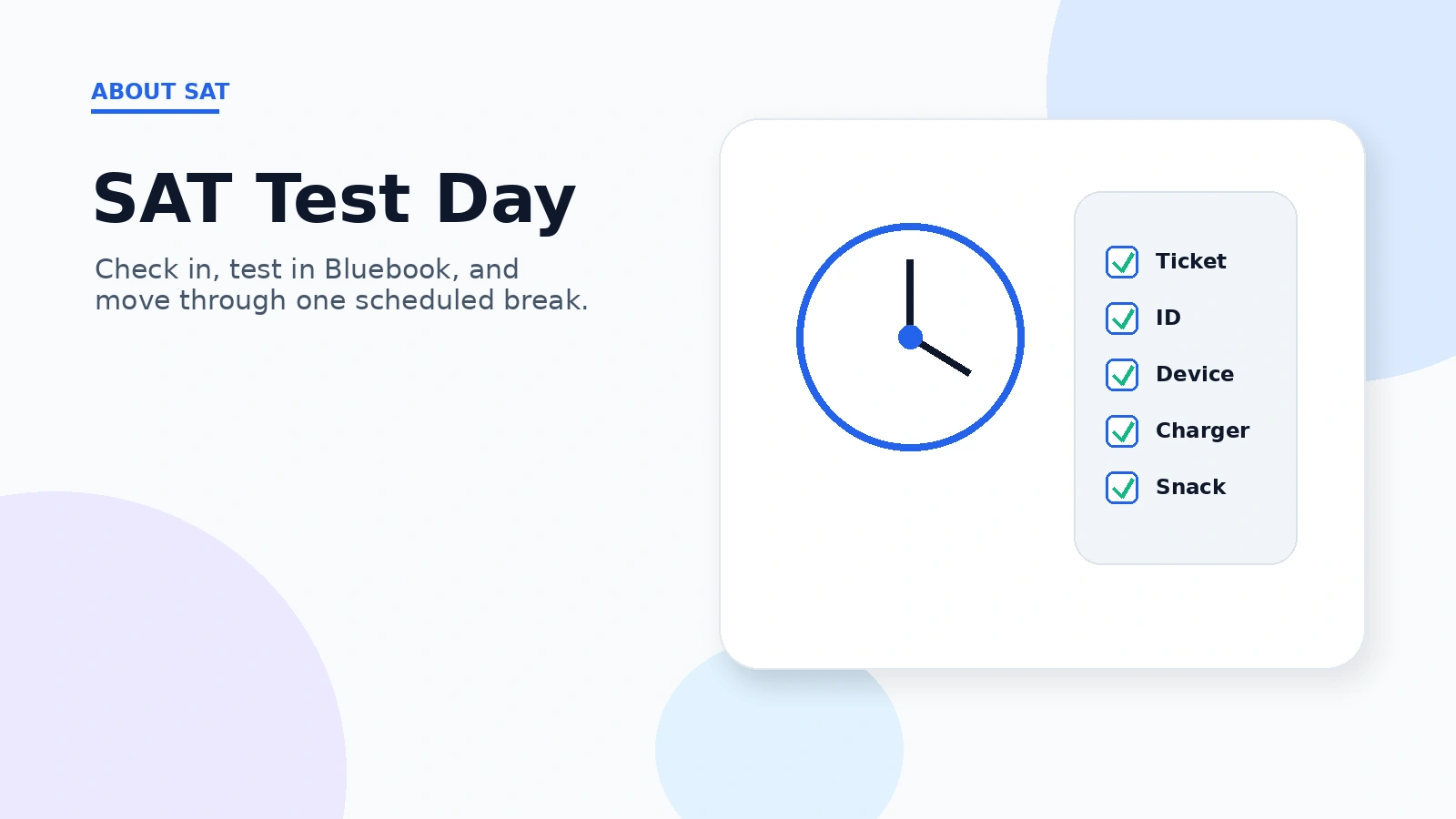
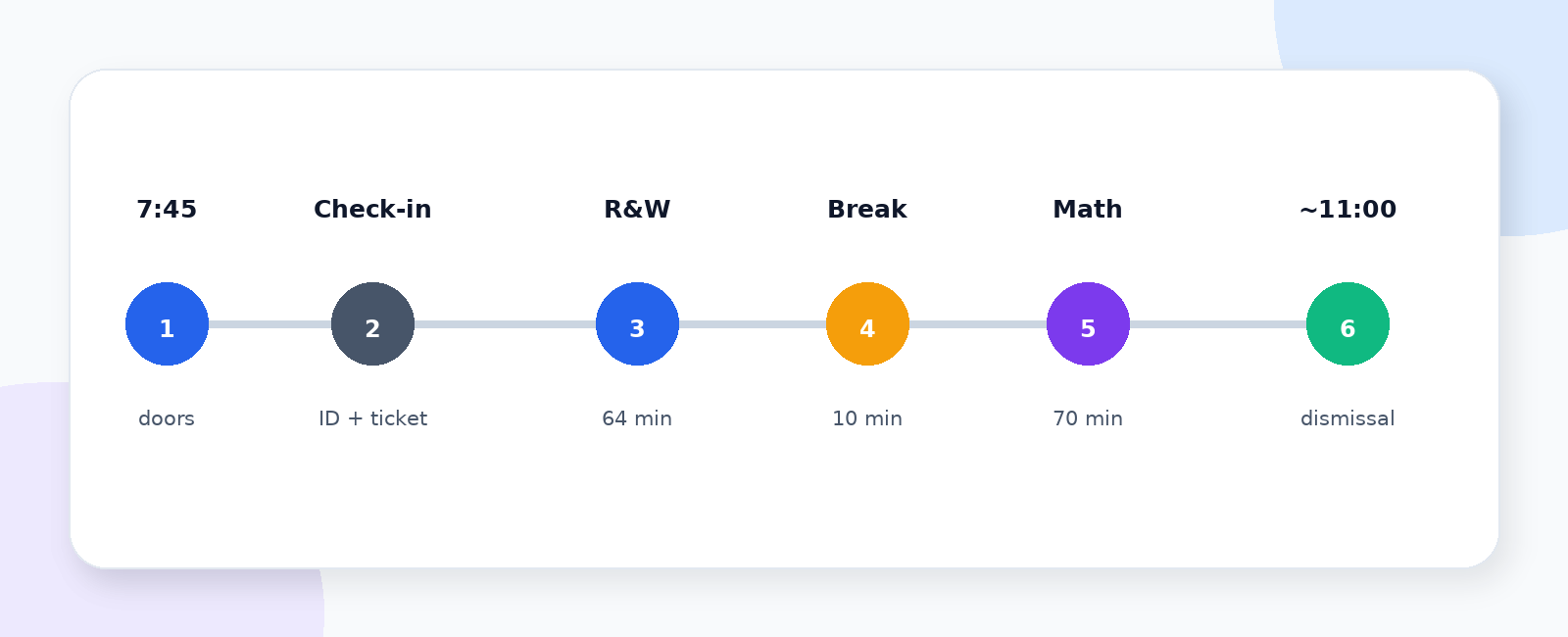
On SAT test day you will arrive at your center by about 7:45 a.m., check in with a printed admission ticket and a valid photo ID, and test on your own or a borrowed device using the College Board’s Bluebook app. The digital test runs 2 hours and 14 minutes with one 10-minute break. Knowing the routine in advance removes most of the stress. Here is exactly how the day works.
What to expect on SAT test day
Doors typically open around 7:45 a.m. and close before testing begins, so arriving late can mean being turned away. Check-in involves verifying your identity, finding your seat, and following the proctor’s instructions to launch the test in Bluebook.
The test itself is two sections. Reading and Writing comes first (64 minutes in two modules), followed by a 10-minute break, then Math (70 minutes in two modules). With check-in and instructions, plan to be at the center for roughly three to four hours even though the testing time is 2 hours and 14 minutes.
What to bring (and what to leave home)
Pack everything the night before so you are not scrambling in the morning. Bring these items:
Your printed admission ticket from your College Board account.
A valid photo ID whose name matches your registration exactly.
A fully charged testing device (laptop or tablet) with Bluebook installed and exam setup completed, unless you requested a school or College Board device.
Your charger or a power strip, since outlets are not guaranteed.
An acceptable calculator if you prefer your own, though Bluebook includes a built-in Desmos graphing calculator for the entire Math section.
Snacks and water for the break.
Leave at home anything not allowed in the testing room: phones and smartwatches must be off and put away, and using one during the test can cancel your scores. Scratch paper is provided by the proctor.
Using Bluebook on test day
The SAT is taken inside Bluebook, the College Board’s testing app. Install it well before test day and complete the required exam setup, which confirms your device works and downloads the test so it runs even if the Wi-Fi drops.
Bluebook includes the tools you need on screen: a countdown timer, a flag-for-review marker, an answer-eliminator, an annotation tool, and the Desmos graphing calculator. Spend a little time before test day getting comfortable with these so they feel natural during the test. For a fuller picture of the sections and tools, see our guide on the Digital SAT format.
A sample test day timeline
Time
What happens
7:45 a.m.
Doors open; check in with admission ticket and ID
8:00-8:30 a.m.
Seating, proctor instructions, launch Bluebook
Morning
Reading and Writing section, 64 minutes
Mid-test
10-minute break
Late morning
Math section, 70 minutes
~11:00 a.m.
Submit, follow dismissal instructions
Exact timing varies slightly by center, but the sequence is consistent.
The night before and the morning of
The night before, charge your device, lay out your ticket and ID, and aim for a normal, full night of sleep rather than last-minute cramming, which tends to hurt more than it helps. Eat a normal breakfast so hunger does not distract you during the test.
If you have prepared steadily, test day is about execution, not new learning. Trust your preparation, pace yourself through the first module of each section, and answer every question, since there is no penalty for a wrong answer. When you are ready to book your date, our guides on SAT test dates and how to register for the SAT cover the logistics.
Frequently asked questions about SAT test day
Q: What time does the SAT start? A: Doors usually open around 7:45 a.m. and testing begins after check-in and instructions, often between 8:30 and 9:00 a.m. Arrive early, because late arrivals may not be admitted.
Q: What do I need to bring on SAT test day? A: Your printed admission ticket, a valid photo ID matching your registration, a charged device with Bluebook ready, a charger, an optional approved calculator, and snacks for the break.
Q: Can I use my phone during the SAT? A: No. Phones and smartwatches must be off and stored away. Using one during the test or the break can result in your scores being cancelled.
Q: Do I need my own calculator? A: Not necessarily. Bluebook includes a Desmos graphing calculator you can use for the entire Math section, though you may bring an approved calculator if you prefer one.
Q: How long is SAT test day? A: The test is 2 hours and 14 minutes of testing plus a 10-minute break, but with check-in and instructions you should expect to be at the center for about three to four hours.
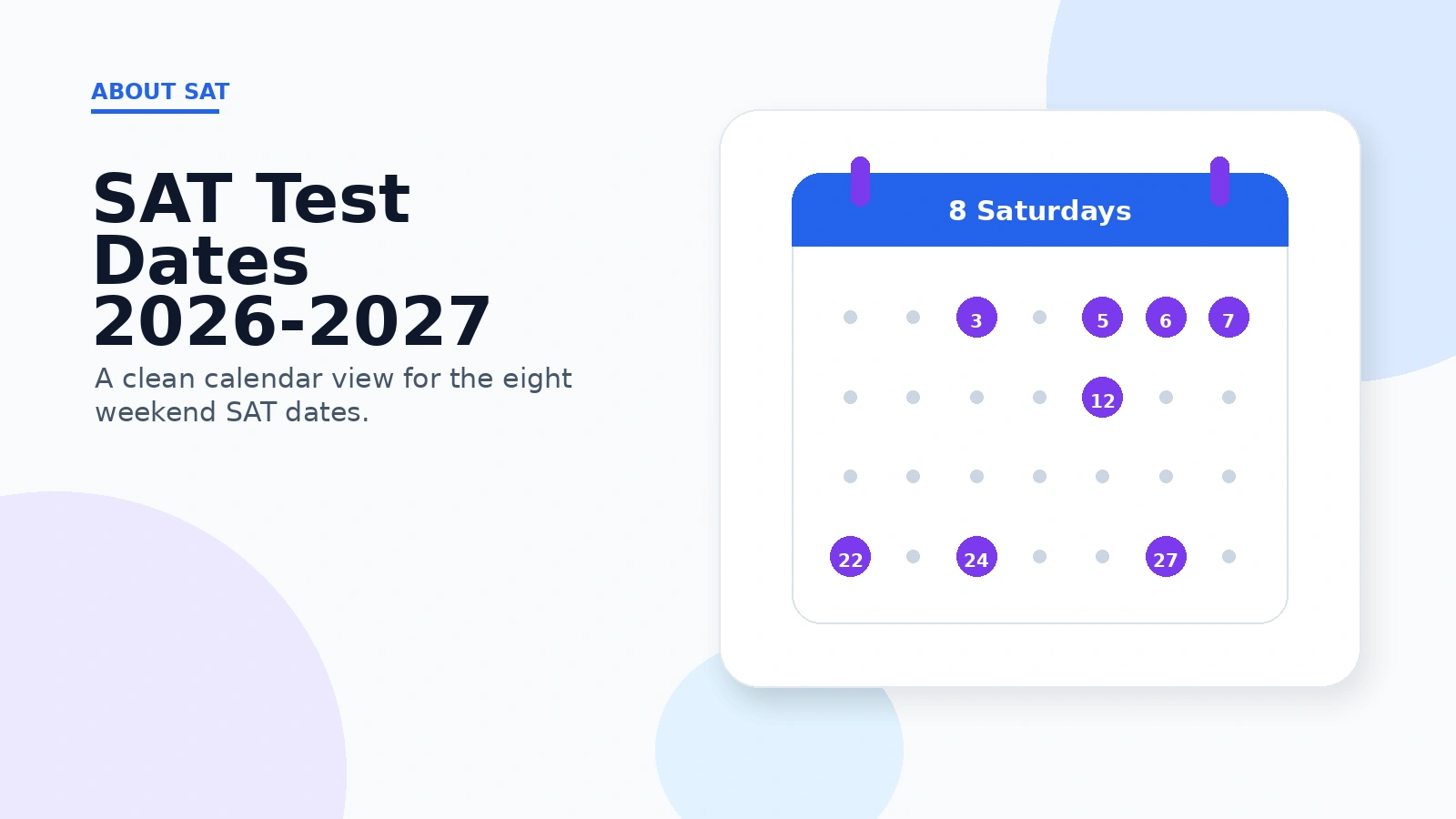
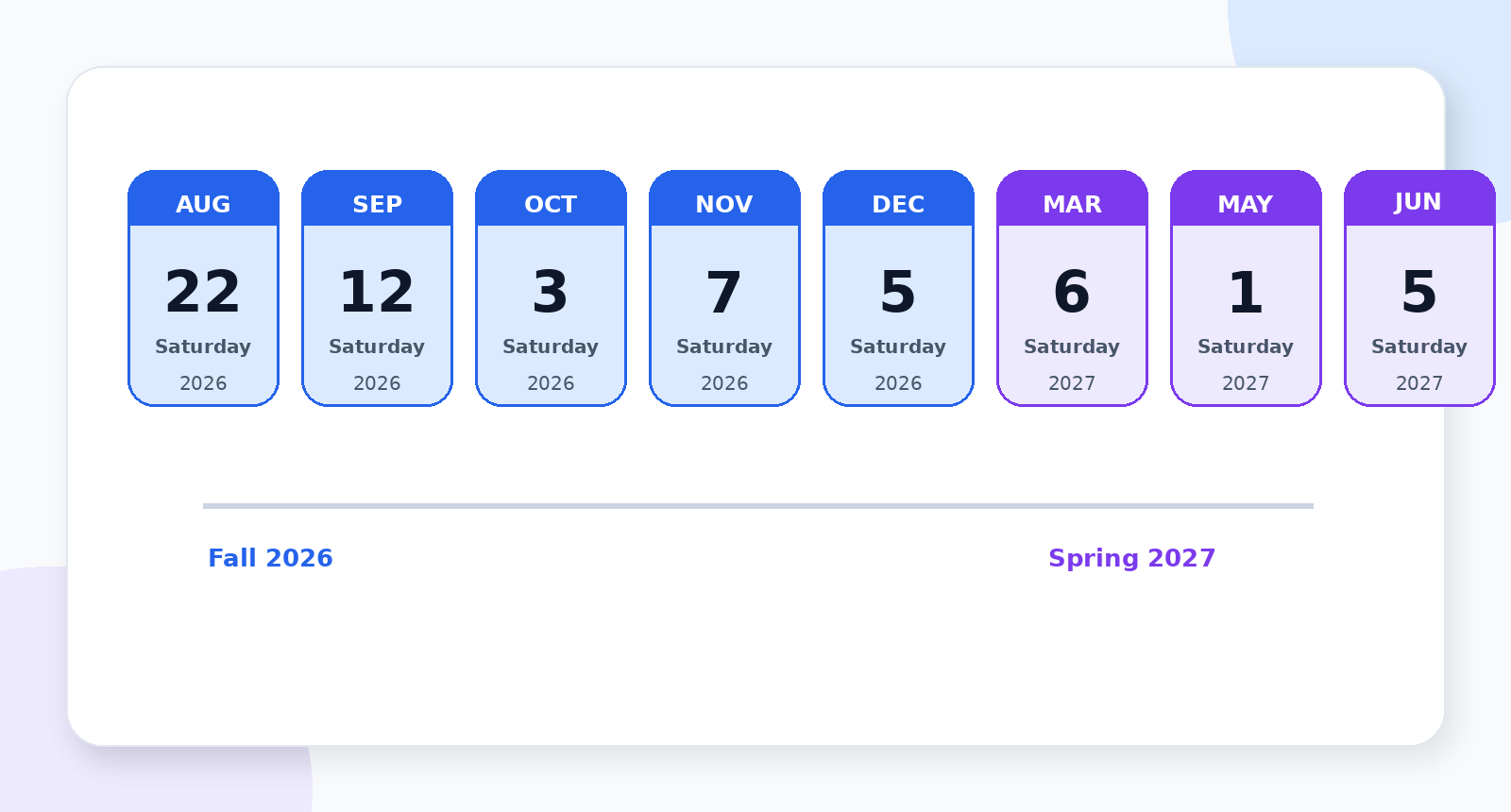
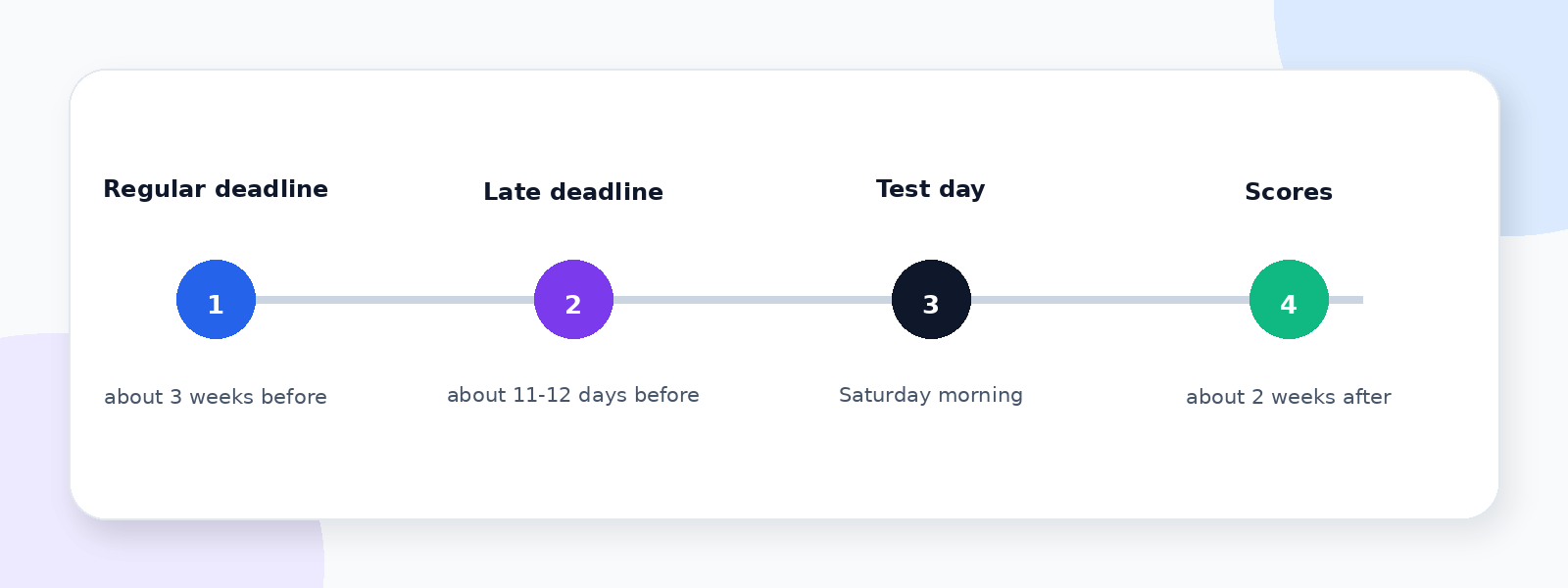
The SAT test dates for the 2026-2027 testing year fall on eight Saturdays: August 22, September 12, October 3, November 7, and December 5 in 2026, then March 6, May 1, and June 5 in 2027. Regular registration closes about three weeks before each date, and digital scores arrive about two weeks after you test. Always confirm the current dates on the College Board website before you register, since they can change.
SAT test dates and deadlines for 2026-2027
The table below lists every weekend SAT date for the 2026-2027 year with its regular registration deadline and, where the College Board has posted it, the score release date. Late registration is available for roughly 11 to 12 days after the regular deadline for an added fee.
Test date
Regular deadline
Scores released
Saturday, August 22, 2026
August 7, 2026
around September 4, 2026
Saturday, September 12, 2026
August 28, 2026
around September 25, 2026
Saturday, October 3, 2026
September 18, 2026
around October 16, 2026
Saturday, November 7, 2026
October 23, 2026
around November 20, 2026
Saturday, December 5, 2026
November 20, 2026
around December 18, 2026
Saturday, March 6, 2027
February 19, 2027
to be announced
Saturday, May 1, 2027
April 16, 2027
to be announced
Saturday, June 5, 2027
May 21, 2027
to be announced
These dates apply to both US and international students. Spring 2027 score-release dates had not been published at the time of writing, so check your College Board account for the exact day once it is posted.
How SAT registration deadlines work
There are two deadlines for every test date. The regular deadline falls about three weeks before the test and gives you the standard fee and the widest choice of test centers. The late deadline falls about 11 to 12 days before the test and adds a late fee, with fewer centers likely to have open seats.
Treat the regular deadline as your real cutoff. Test centers, especially in high-demand areas, can fill well before the deadline, so registering early protects your first-choice location. If you need to borrow a device from the College Board, request it at least 30 days before test day, which is earlier than the normal deadline.
When do SAT scores come out?
Digital SAT scores are typically released about two weeks (roughly 13 days) after the test date, much faster than the three to five weeks the old paper test required. You will see them in your College Board account, along with a domain-by-domain breakdown of your performance.
After your scores post, official reports are sent to the colleges on your list within about 7 to 10 additional days. If you are testing for an Early Decision or Early Action deadline, work backward from the college’s deadline to make sure your scores will arrive in time.
How to choose the right SAT test date
Pick a date that leaves room for a retake before your application deadlines. Many students take the SAT for the first time in the spring of junior year (March, May, or June) and keep the early fall of senior year (August, September, or October) open for a second attempt.
If you are applying Early Decision or Early Action, the October test is often the last date whose scores will reliably arrive before a November 1 or November 15 deadline. Confirm each college’s score deadline before you commit, then register as early as you can. For help deciding how far ahead to begin studying, see our guide on when to start SAT prep, and when you are ready, our walkthrough on how to register for the SAT covers the full process.
Frequently asked questions about SAT test dates
Q: How many times is the SAT offered each year? A: For 2026-2027 the SAT is offered on eight Saturdays: five in fall 2026 (August through December) and three in spring 2027 (March, May, and June). There is no national test in January, February, April, or July.
Q: Are SAT test dates the same for international students? A: Yes. For the 2026-2027 weekend schedule, the College Board lists the same dates and deadlines for US and international test-takers, though international registration carries an added fee.
Q: How late can I register for the SAT? A: Late registration stays open for roughly 11 to 12 days after the regular deadline and adds a late fee. After the late deadline closes, you generally cannot register for that date.
Q: How soon will I get my SAT scores? A: Usually about two weeks after your test date, viewable in your College Board account. Reports reach colleges about 7 to 10 days after that.
Q: Could these dates change? A: The College Board can adjust dates and deadlines, and spring 2027 details may still be finalized. Always verify the current schedule on the official College Board dates and deadlines page before registering.