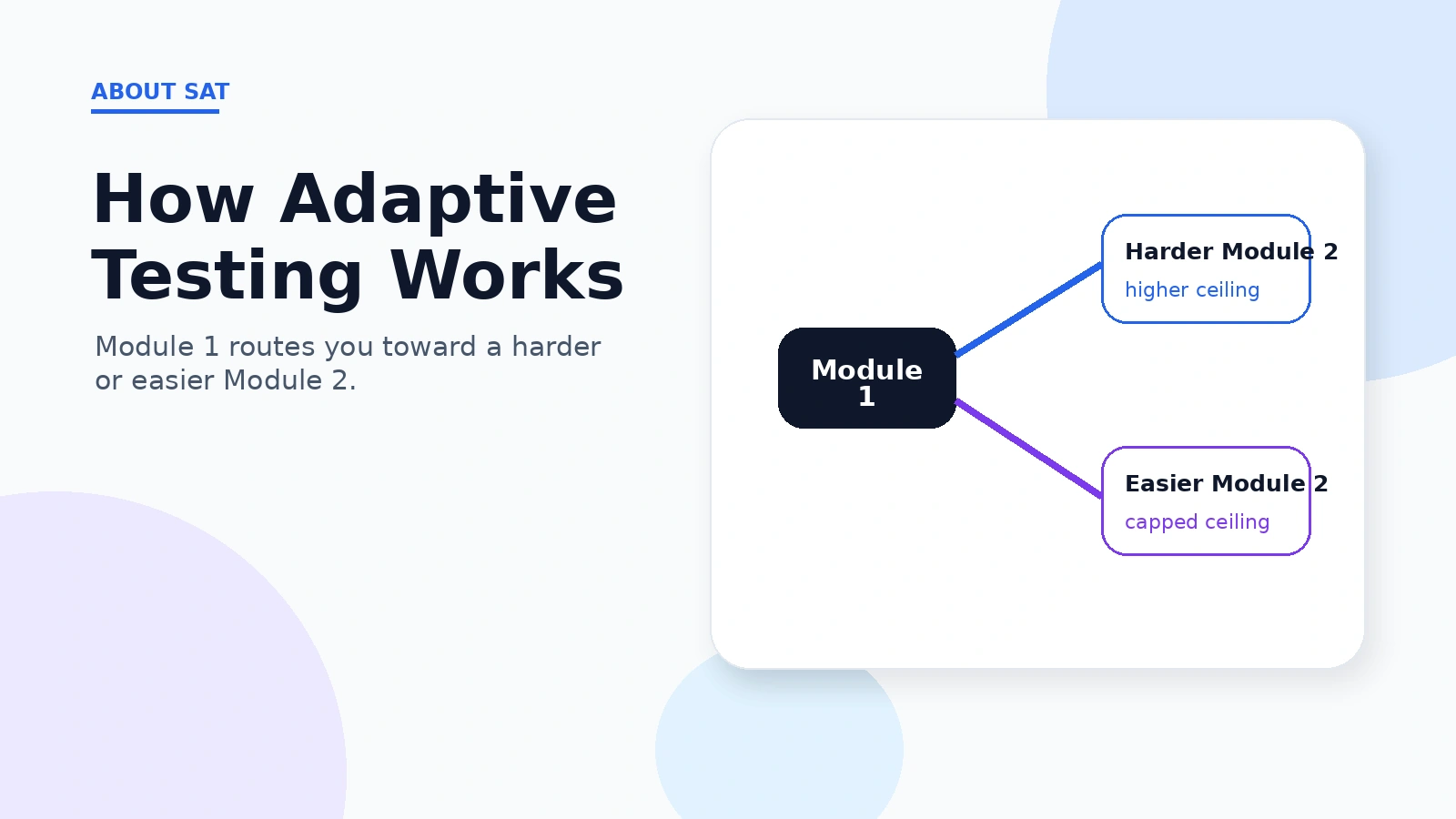
Digital SAT adaptive testing means the test adjusts its difficulty based on your performance, but it does so by section, not question by question. Each section has two modules; everyone takes the same first module, and how you do on it decides whether your second module is the harder or the easier version. The harder version is what unlocks the top of the score range.
What Digital SAT adaptive testing actually is
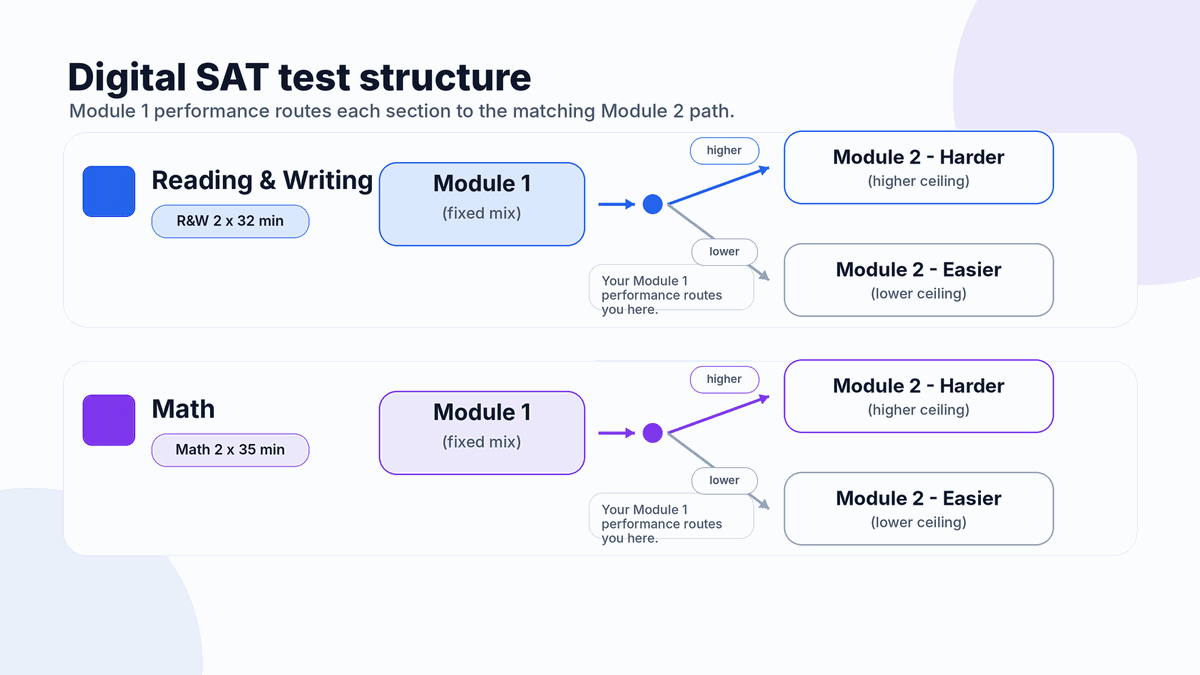
The Digital SAT uses what the College Board calls multistage adaptive testing. The test does not change difficulty after every answer. Instead, it groups questions into modules and adapts once, between the first and second module of each section.
This matters because a common misconception is that the SAT now reacts to each individual answer, like some other computer tests. It does not. You can move freely within a module, change answers, and flag questions to revisit, all without affecting anything until you submit that module.
How the two modules work
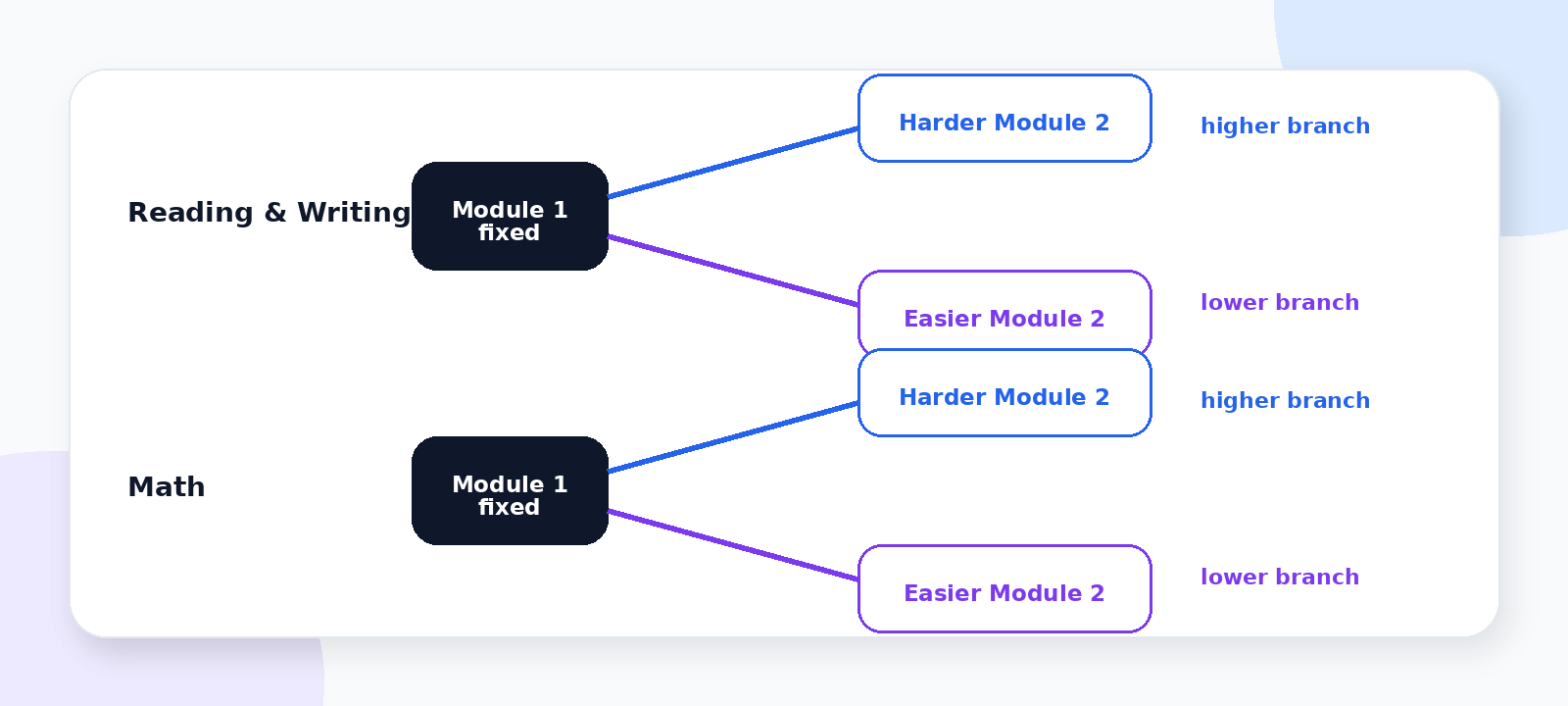
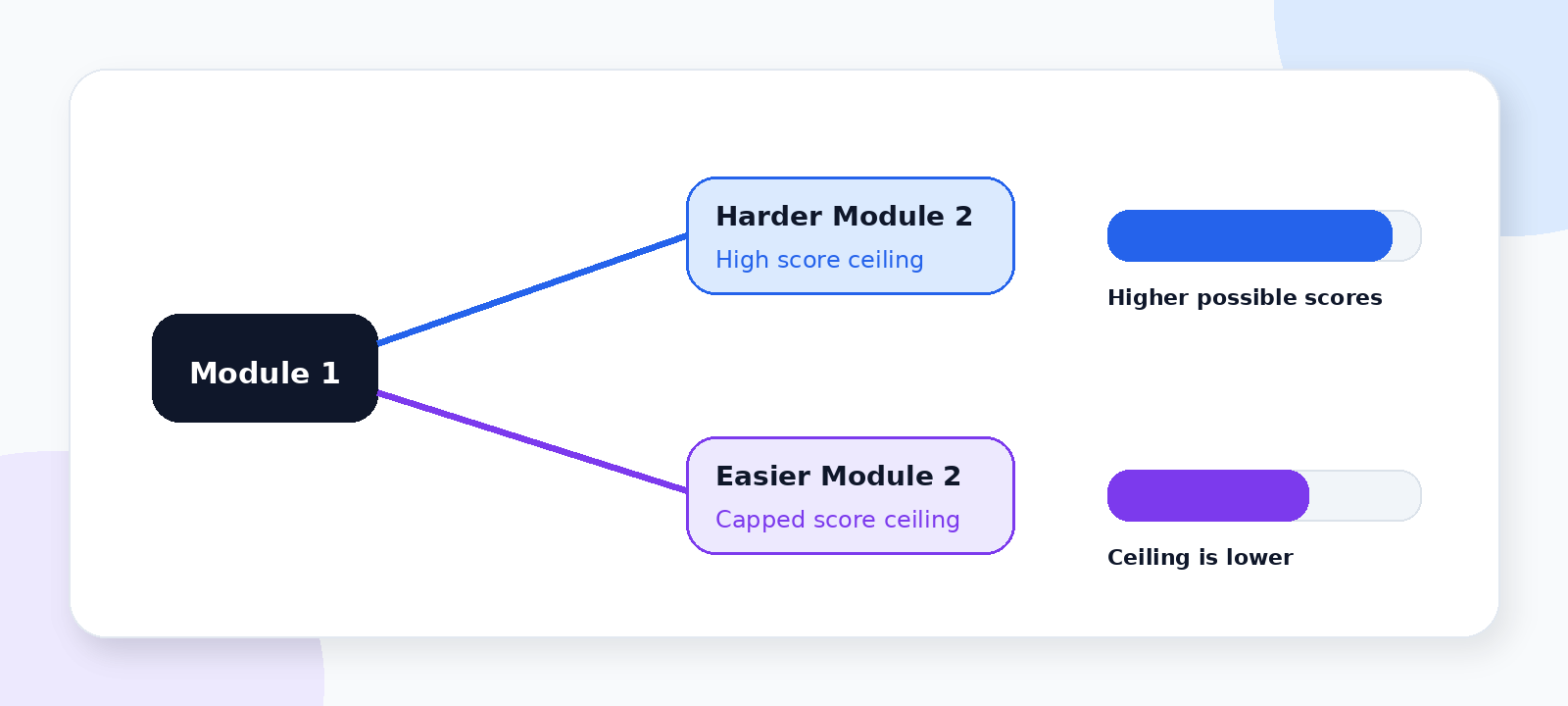
Each section, Reading and Writing and Math, is delivered in two parts. Module 1 contains a fixed mix of easy, medium, and hard questions that every test taker sees. Module 2 then arrives at one of two difficulty levels, chosen by your Module 1 performance.
Routing to the harder Module 2 gives you access to the highest scores in that section. Routing to the easier Module 2 places a lower cap on your possible score for that section. The two sections route independently, so you might get the harder Math module and the easier Reading and Writing module, or any combination.
Stage
What happens
Module 1 (both sections)
Same fixed mix for everyone; sets your routing
Strong Module 1
Routed to harder Module 2, higher score ceiling
Weaker Module 1
Routed to easier Module 2, lower score ceiling
Across modules
You cannot return to Module 1 after submitting it
Why Module 1 is the highest-leverage part of the test
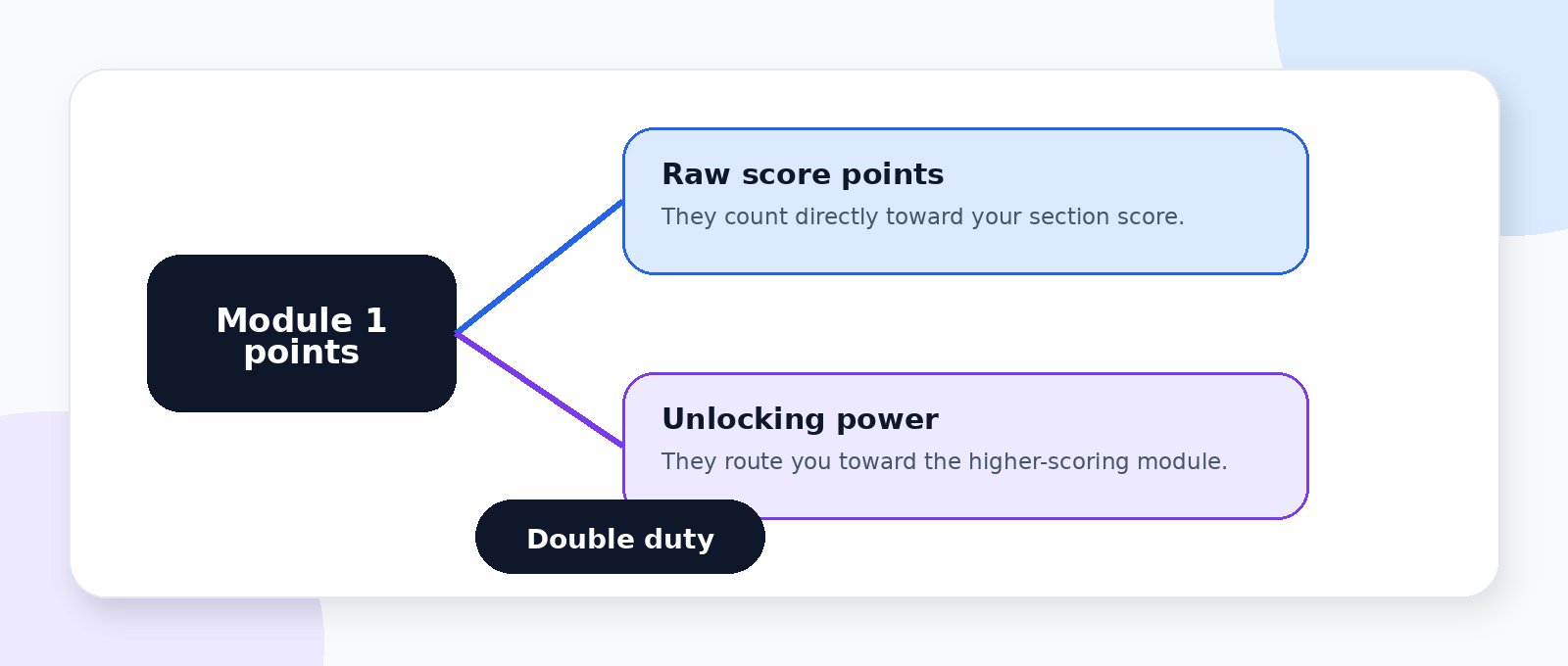
Because Module 1 determines which scoring tier you can reach, it is the most important stretch of each section. Points you secure early do double duty: they count toward your raw score and they unlock the harder module where the top scores live.
The practical takeaway is to treat the first module of each section with full focus and good pacing, rather than rushing it to save time for later. You cannot make up a missed routing opportunity in Module 2.
What this means for how you prepare
Adaptive testing rewards consistency under time pressure across the whole ability range, since Module 1 mixes easy, medium, and hard questions. Practicing only easy questions leaves you unprepared for the hard items that influence routing, and drilling only hard questions can cost you the easy points the test expects you to get.
The most efficient preparation targets your weakest content domains so your Module 1 performance improves where it is currently leaking points. To find those domains, start from the Digital SAT syllabus, and to see how routing feeds the final number, read how the Digital SAT is scored. At Prism Learning, practice tests mirror the adaptive structure so you train under the same routing pressure you will face on test day.
Frequently asked questions about Digital SAT adaptive testing
Q: Is the Digital SAT adaptive question by question? A: No. It is section-adaptive, also called multistage adaptive. It adjusts once between the two modules of each section, based on your first-module performance, not after each individual question.
Q: Can I go back and change answers? A: Yes, within the module you are currently working on. Once you submit a module, you cannot return to it or change those answers.
Q: Does the harder second module really raise my score? A: Yes. The harder Module 2 carries access to the highest scores in that section. If you are routed to the easier Module 2, your ceiling for that section is lower.
Q: Do both sections adapt the same way? A: Each section adapts independently. Your Math routing and your Reading and Writing routing are decided separately by your performance on each section’s first module.
Q: How should adaptive testing change my prep? A: Prioritize a strong, well-paced first module in each section, and prepare across the full difficulty range rather than only easy or only hard questions, since Module 1 mixes all levels.
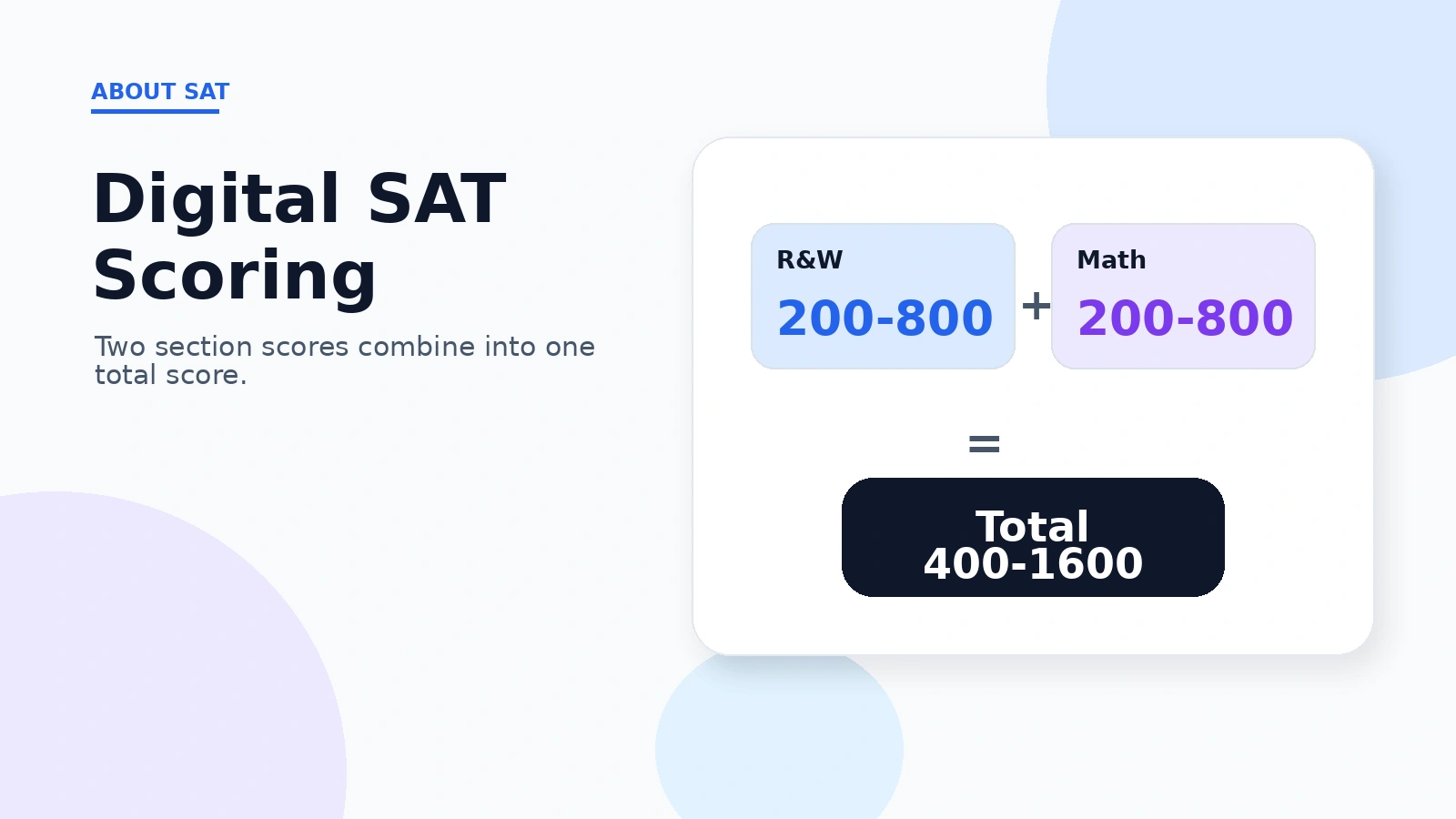
Digital SAT scoring works on a 400 to 1600 scale, built from two section scores of 200 to 800 each: one for Reading and Writing and one for Math. Your raw answers are converted to scaled scores through a process called equating, and because the test is adaptive, the difficulty you unlock also shapes your ceiling. Here is how it all fits together.
How Digital SAT scoring works
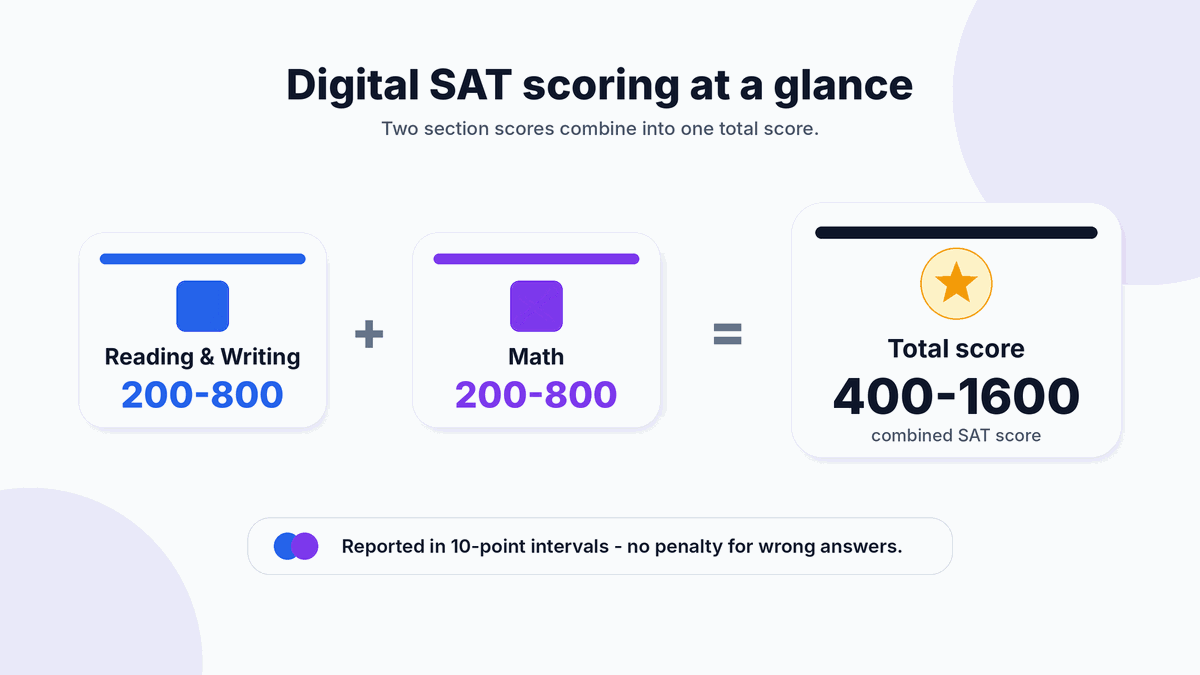
Your total score is simply the sum of your two section scores. Reading and Writing is scored from 200 to 800, Math is scored from 200 to 800, and together they produce a total from 400 to 1600. There is no separate essay or combined sub-score to worry about on the current test.
Scores are reported in 10-point intervals, so a 690 or a 700 is possible, but a 691 is not. There is also no penalty for a wrong answer, so every question you answer correctly can only help you.
From raw score to scaled score
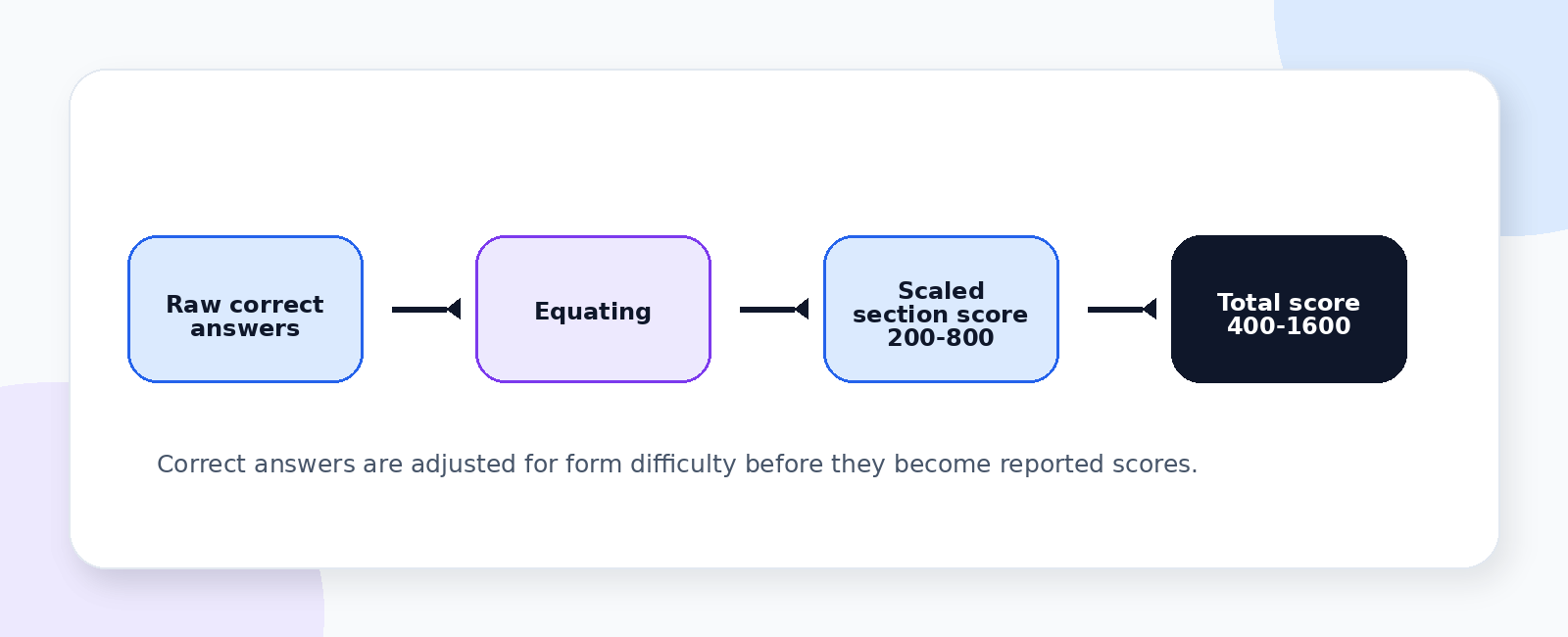
Your raw score is the number of questions you answered correctly. The College Board then converts that raw score into the 200 to 800 scaled score for each section using a statistical process called equating, which adjusts for small differences in difficulty between test forms.
Equating is why a given scaled score means the same thing on any test date. A 700 earned on a slightly harder form represents the same ability as a 700 earned on a slightly easier form, so you are never penalized or rewarded for which form you happened to sit.
Why the adaptive design affects your score
Digital SAT scoring is tied to the test’s adaptive structure. Each section has two modules; your performance on Module 1 routes you into a harder or an easier Module 2. The harder Module 2 carries access to the highest scores in that section, while the easier Module 2 caps how high you can go.
This means raw correct answers are not the whole story. Two students who answer the same number of questions correctly can earn different section scores if one was routed into the harder module and the other was not. For the full mechanic, see how Digital SAT adaptive testing works.
Element
How it scores
Reading and Writing section
200 to 800
Math section
200 to 800
Total score
400 to 1600 (sum of both)
Reporting interval
10-point steps
Wrong answers
No penalty
When you get your scores
Digital scores are typically released within about two weeks of your test date, much faster than the three to five weeks the old paper test required. You access them through your College Board account, which also shows a domain-level breakdown of your performance.
That domain breakdown is the most useful part of the report for planning a retake, because it shows exactly which content areas cost you points. To see those domains, read the Digital SAT syllabus.
What counts as a good score
A “good” Digital SAT score depends entirely on the colleges you are targeting, since each school reports its own admitted-student range. Rather than chasing a single universal number, compare your score to the middle 50% range published by your target schools.
Many colleges also superscore, combining your highest Reading and Writing score and your highest Math score across multiple test dates. That can change how you plan a retake, because you only need to raise one section at a time.
Frequently asked questions about Digital SAT scoring
Q: What is the Digital SAT score range? A: The total ranges from 400 to 1600, made up of two section scores from 200 to 800 each (Reading and Writing, and Math). Scores are reported in 10-point intervals.
Q: Is there a penalty for wrong answers? A: No. Only correct answers count toward your raw score, so you should answer every question rather than leaving any blank.
Q: How does adaptive testing change my score? A: Performing well on the first module of a section routes you into a harder second module, which unlocks the highest scores. An easier second module limits your ceiling for that section.
Q: How soon do Digital SAT scores come out? A: Usually within about two weeks of the test date, viewable in your College Board account along with a domain-by-domain breakdown.
Q: Does the SAT still have an essay? A: No. The current Digital SAT has no essay; your score is built only from the Reading and Writing and Math sections.
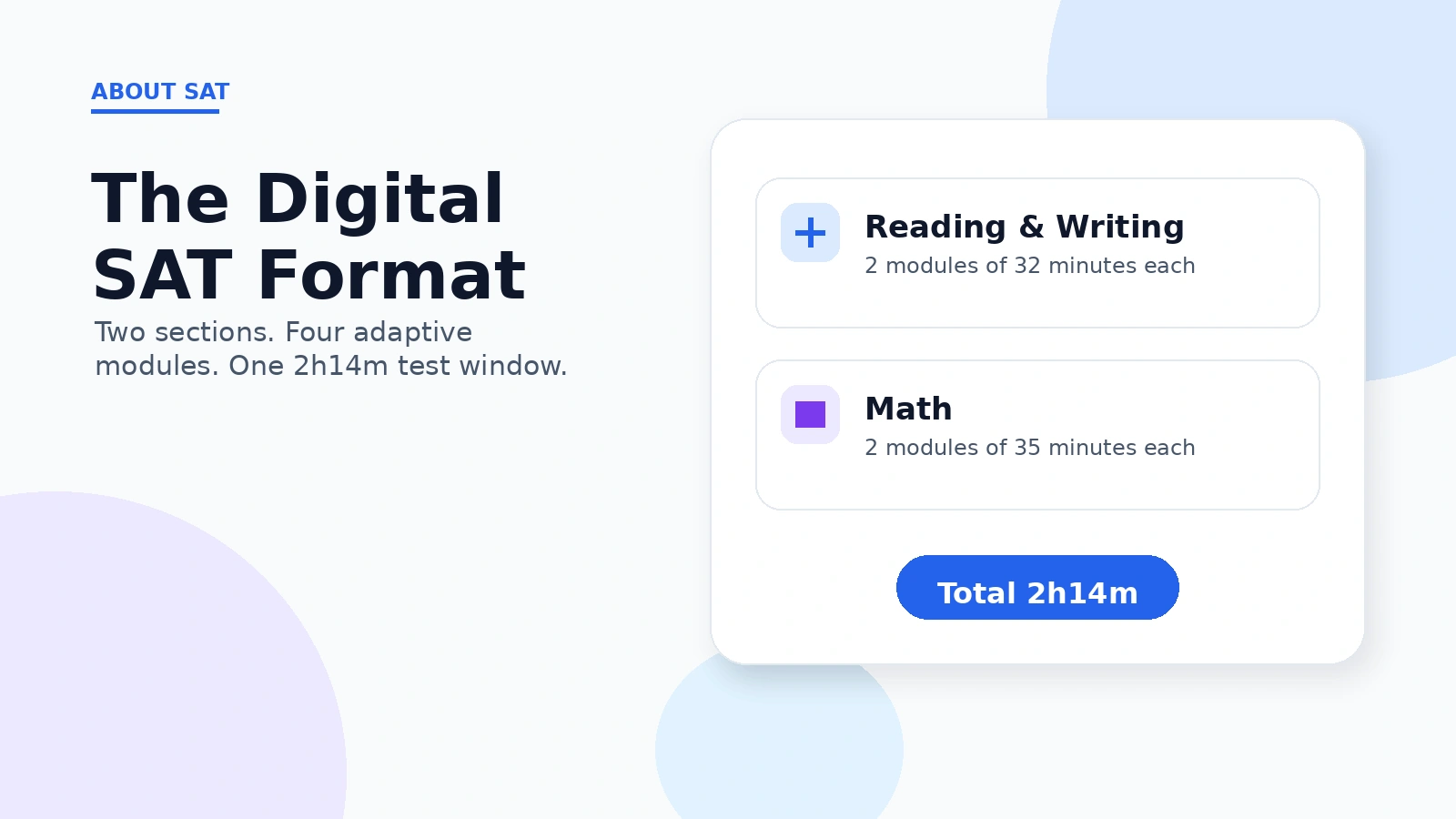
The Digital SAT format is a fully computer-based, section-adaptive test of 98 questions taken in 2 hours and 14 minutes across two sections: Reading and Writing, and Math. Each section splits into two separately timed modules, and the difficulty of your second module adapts to how you did on the first. Here is exactly how the format works.
What is the Digital SAT format?
Since March 2024, every SAT in the United States is taken digitally in the College Board’s Bluebook app, and the same format applies through the 2025 and 2026 testing years. It replaced the old three-hour paper test with a shorter, adaptive exam that most students find less draining.
Three features define the Digital SAT format: it is shorter (about 2 hours 14 minutes of testing versus three hours on paper), it is section-adaptive (the test adjusts difficulty between modules), and it is digital end to end, with a built-in timer, calculator, and annotation tools.
The two sections and four modules
The test has two scored sections, Reading and Writing and Math, and each is delivered as two separately timed modules. That gives four modules in total. You cannot return to a previous module once you submit it, though you can move freely among questions within the module you are on.
Section
Modules
Questions
Time
Reading and Writing
2 modules of 27 questions
54
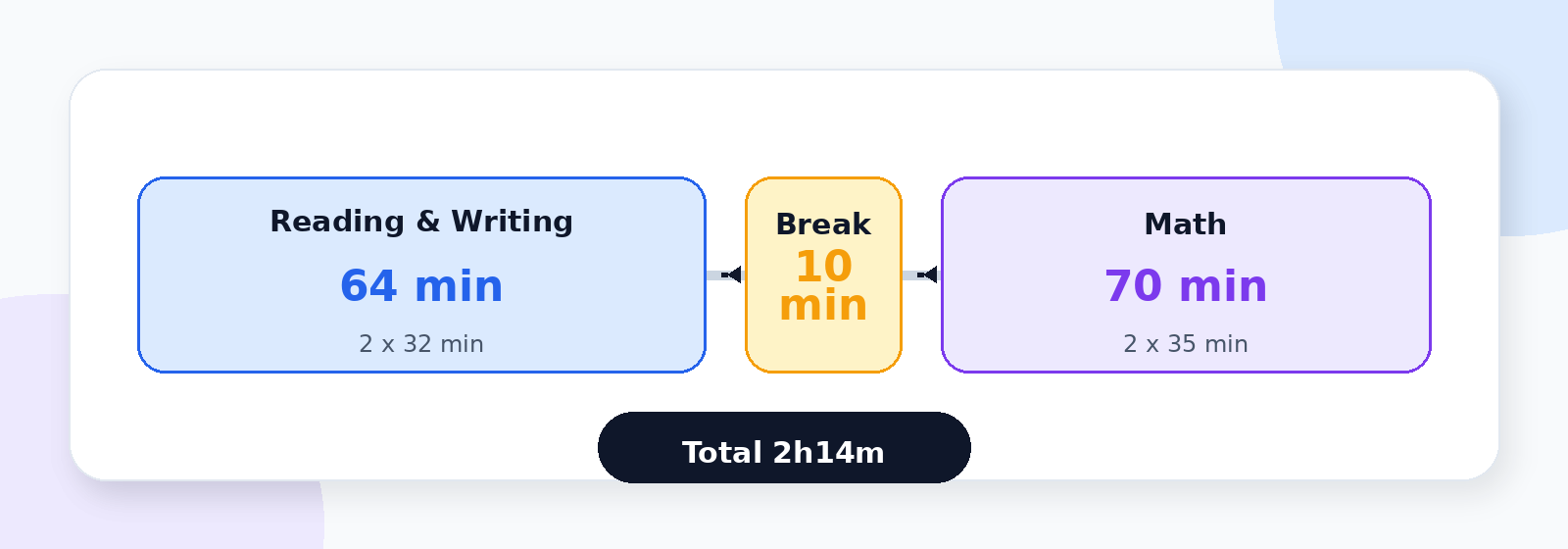
64 minutes (32 per module)
Math
2 modules of 22 questions
44
70 minutes (35 per module)
Total
4 modules
98
2 hours 14 minutes
A 10-minute break sits between the Reading and Writing section and the Math section. Of the 98 questions, 4 are unscored pretest questions (2 per section) that the College Board uses to trial future items; you cannot tell which they are, so answer every question.
How long is the Digital SAT?
The Digital SAT format runs 2 hours and 14 minutes of actual testing time, not counting the break or check-in. Plan for a longer morning at the test center, since check-in and instructions add time before testing begins.
The shorter length is possible because the digital test uses fewer, more efficient questions and shorter reading passages. Compared with the old paper SAT, students get noticeably more time per question.
Question types you will see
Reading and Writing is entirely multiple choice, with four answer options per question and one short passage (roughly 25 to 150 words) attached to each question. Instead of long passages followed by many questions, you read many short, self-contained texts.
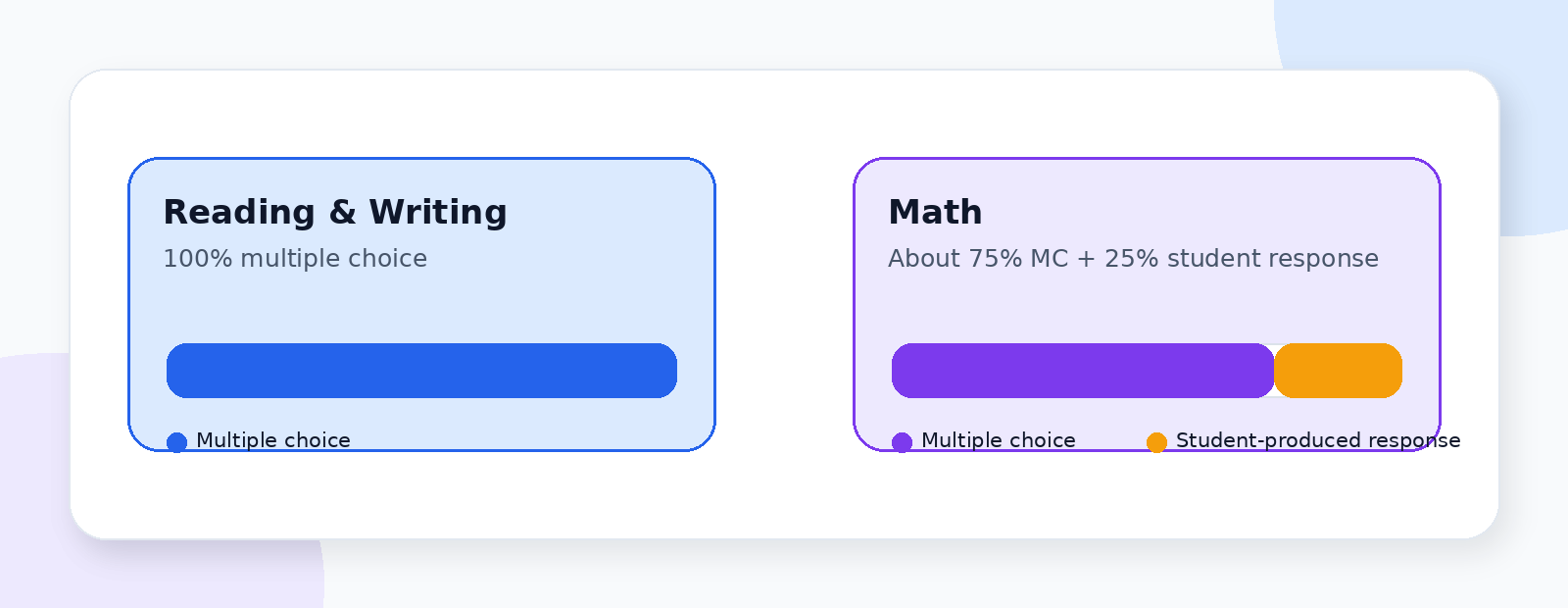
Math mixes two formats. About 75% of Math questions are multiple choice, and about 25% are student-produced responses, where you type a numerical answer into a box with no options to choose from. A calculator is allowed on every Math question.
Tools built into the test
Bluebook includes everything you need on screen: a countdown timer, a flag-for-review tool, an answer eliminator, and the Desmos graphing calculator for the entire Math section. You may also bring your own approved calculator, but most students rely on the built-in Desmos.
There is no penalty for a wrong answer. Because only correct answers count, you should answer every question, even if you have to guess near the end of a module.
How the adaptive format works
The Digital SAT is section-adaptive, not question-adaptive. Everyone sees the same first module in each section. Your performance on Module 1 then routes you to a harder or an easier Module 2, and the harder path is what makes the top of the score range reachable. For the full mechanic and what it means for your strategy, see our guide on how Digital SAT adaptive testing works.
Frequently asked questions about the Digital SAT format
Q: How many questions are on the Digital SAT? A: There are 98 questions in total: 54 in Reading and Writing and 44 in Math. Four of these (two per section) are unscored pretest questions used for future test development.
Q: How long is the Digital SAT? A: The testing time is 2 hours and 14 minutes, plus a 10-minute break between sections. Allow extra time at the center for check-in and instructions.
Q: Is the whole SAT multiple choice? A: Reading and Writing is fully multiple choice. Math is about 75% multiple choice and about 25% student-produced response, where you type in your own numerical answer.
Q: Can I use a calculator on the Digital SAT? A: Yes, on the entire Math section. Bluebook has a built-in Desmos graphing calculator, and you may bring your own approved calculator as well.
Q: Can I go back to a previous question or module? A: You can move freely among questions within your current module, but once you submit a module you cannot return to it.
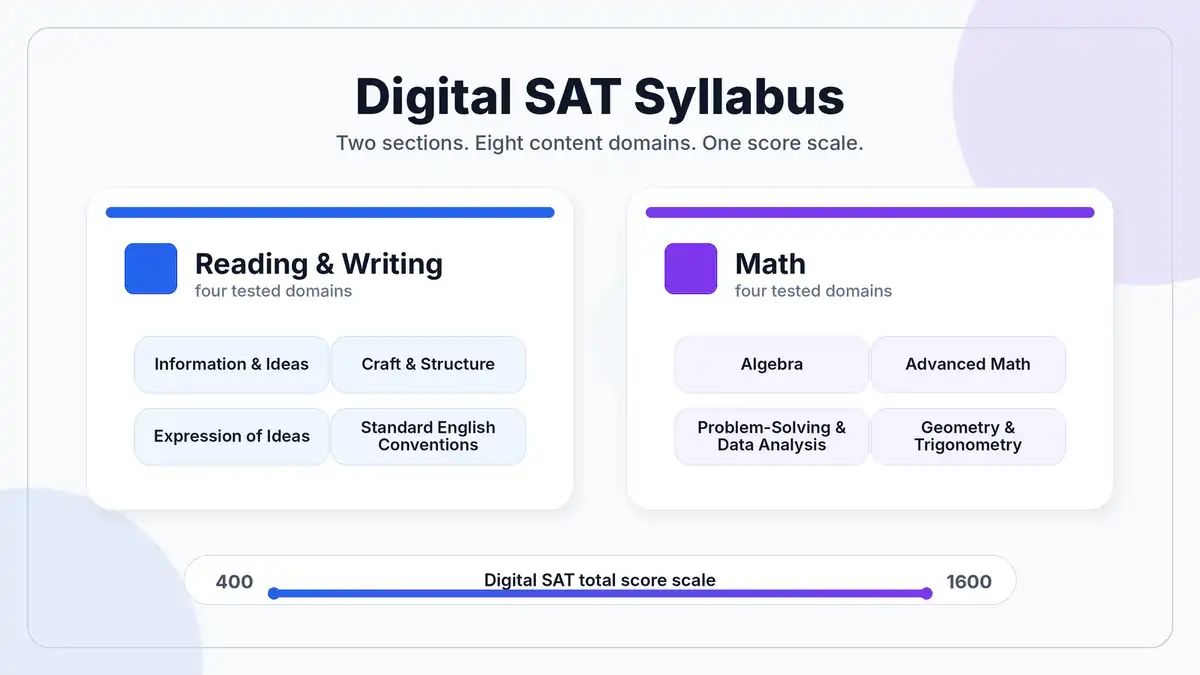
The Digital SAT syllabus covers two sections, Reading and Writing and Math, spread across eight content domains. Reading and Writing tests four of them (Information and Ideas, Craft and Structure, Expression of Ideas, and Standard English Conventions), and Math tests four more (Algebra, Advanced Math, Problem-Solving and Data Analysis, and Geometry and Trigonometry). This guide breaks down every topic, how each is weighted, and how the test is scored.
What the Digital SAT syllabus covers
The Digital SAT is a fully computer-based, section-adaptive test scored on the 400 to 1600 scale. Since March 2024 every student in the United States takes this digital version in the College Board’s Bluebook app, and the same format applies through the 2025 and 2026 testing years.
There are two scored sections, each split into two separately timed modules:
Section
Questions
Time
Format
Reading and Writing
54
64 minutes (two 32-min modules)
All multiple choice, 4 options
Math
44
70 minutes (two 35-min modules)
~75% multiple choice, ~25% type-in answers
Total
98
2 hours 14 minutes of testing
Plus a 10-minute break between sections
The single most important feature of the syllabus is that it is section-adaptive. Everyone sees the same Module 1 in each section. How you do on Module 1 decides whether your Module 2 is the harder or the easier version, and only the harder version unlocks the top of the scoring range. That makes a strong Module 1 the highest-leverage part of the whole test.
Two rules apply across both sections. There is no penalty for a wrong answer, so you should answer every question. And the built-in Desmos graphing calculator is available for the entire Math section.
A small note for planning: of the 98 questions, 4 are unscored pretest questions (2 per section) that the College Board uses to trial future items. You cannot tell which ones they are, so treat every question as if it counts.
Reading and Writing: the four domains tested
The Reading and Writing section has 54 questions across two 32-minute modules. Each question comes with its own short passage of roughly 25 to 150 words, so you read many short texts rather than a few long ones, and every question is multiple choice with four options. The section is built from four domains.
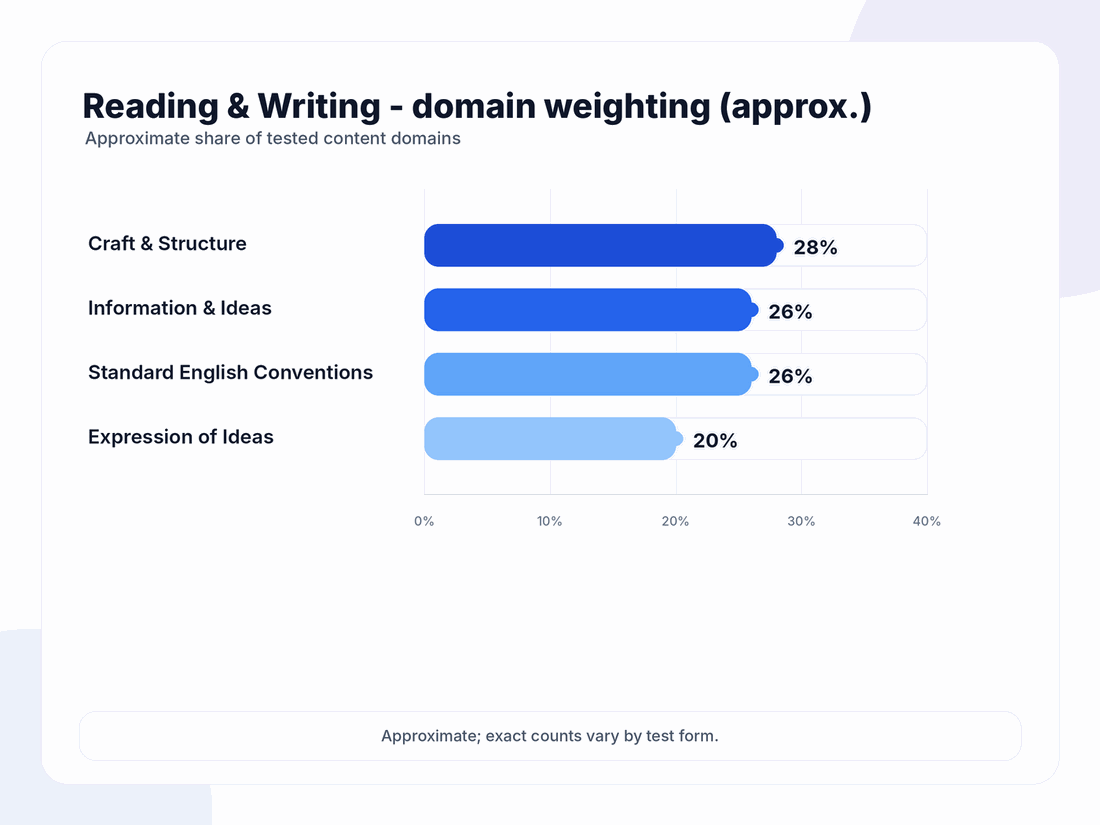
Information and Ideas (about 26% of the section)
This domain is about what a text says and what you can reasonably conclude from it. It tests three skills: identifying central ideas and details, command of evidence, and inferences. Command of evidence appears in two forms, textual (which quotation best supports a claim) and quantitative (reading a value from a graph or table and connecting it to the text). The inference questions ask you to complete a logical conclusion the passage points toward without stating outright.
Craft and Structure (about 28% of the section)
The largest Reading and Writing domain. It covers words in context, where the right meaning depends on the passage rather than the most common dictionary definition; text structure and purpose, which asks how a text is organized and why an author made a choice; and cross-text connections, where you compare how two short related passages treat the same topic. The vocabulary questions here trip up unprepared students most often.
Expression of Ideas (about 20% of the section)
This domain is about effective writing. It tests rhetorical synthesis, where you are given a short list of bulleted notes and must pick the sentence that best accomplishes a stated goal, and transitions, where you choose the word or phrase that correctly links two ideas (contrast, cause and effect, sequence, and so on). It rewards understanding the relationship between ideas, not memorized rules.
Standard English Conventions (about 26% of the section)
This is the grammar and punctuation domain. It covers sentence structure (joining and separating clauses, and avoiding fragments and run-ons), usage (subject-verb agreement, verb tense and form, pronouns, and modifiers), and punctuation (commas, semicolons, colons, dashes, and apostrophes). The rules tested are finite, which makes this the most directly studyable domain in the section.
Math: the four domains tested
The Math section has 44 questions across two 35-minute modules. About 75% are multiple choice and about 25% are student-produced responses, where you type a numerical answer with no options to choose from. A calculator is allowed on every question, and Bluebook includes the Desmos graphing calculator built in. The section covers four domains.
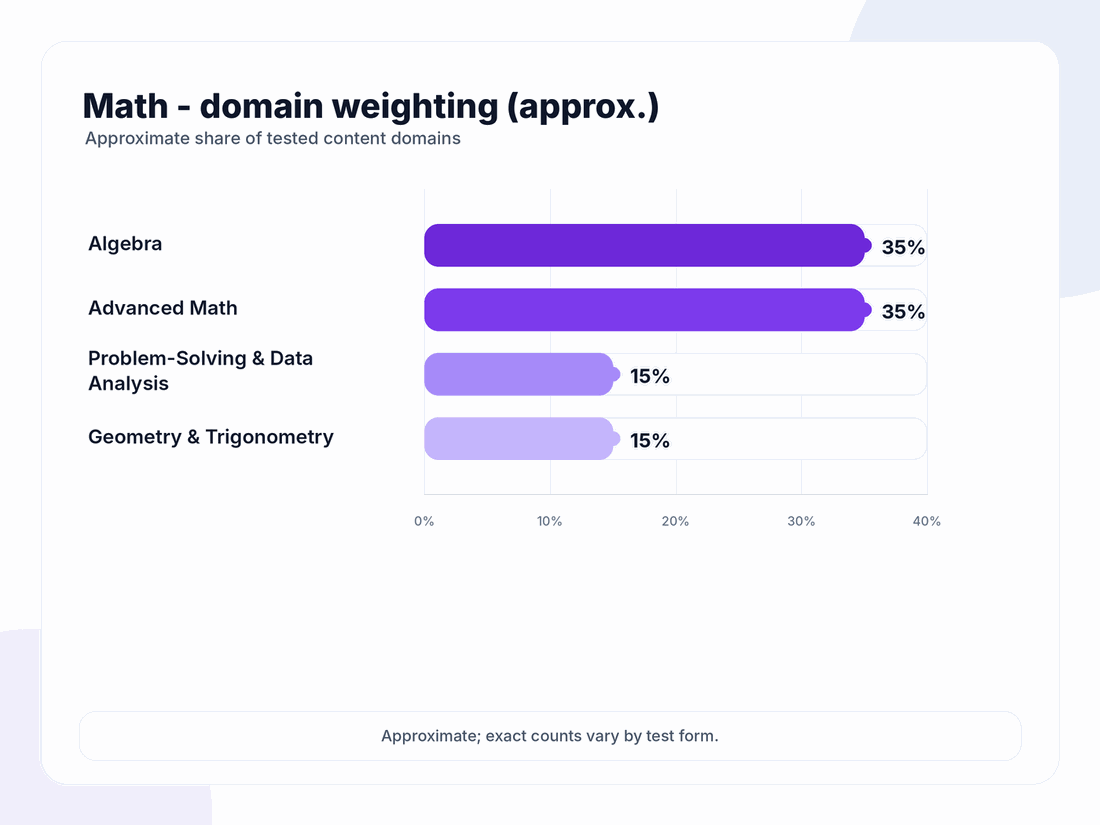
Algebra (about 35% of the section)
The foundation of the Math syllabus. It tests linear equations in one and two variables, linear functions, systems of two linear equations, and linear inequalities. Because it shares the top weighting with Advanced Math, fluency here moves your Math score more than any single Reading and Writing domain moves your verbal score.
Advanced Math (about 35% of the section)
This domain extends algebra into nonlinear territory: creating and recognizing equivalent expressions, working with nonlinear equations and functions (quadratics, exponentials, and polynomials), and solving systems that include a nonlinear equation. Together, Algebra and Advanced Math make up roughly 70% of the Math section.
Problem-Solving and Data Analysis (about 15% of the section)
The applied, real-world domain. It covers ratios, rates, and proportional relationships; percentages; units and unit conversion; probability and the basics of statistics (mean, median, range, and standard deviation as a concept); and interpreting data from tables, graphs, and scatterplots. The math is rarely hard; the challenge is reading the situation correctly.
Geometry and Trigonometry (about 15% of the section)
The smallest domain. It covers area and volume; lines, angles, and triangles; right triangles and basic trigonometry (sine, cosine, tangent, and the Pythagorean theorem); and circles. Many of the formulas you need are provided in the test’s reference sheet, so this domain rewards knowing how to apply formulas more than memorizing them.
How the Digital SAT is scored
Your total score runs from 400 to 1600 and is the sum of two section scores, Reading and Writing (200 to 800) and Math (200 to 800). Scores are reported in 10-point intervals, so a 690 is possible but a 691 is not.
Raw scores (the number of questions you answered correctly) are converted to scaled scores through a process called equating, which adjusts for small differences in difficulty between test forms so that a given score means the same thing on any date. Because the test is adaptive, the difficulty of the Module 2 you were routed into also factors into your ceiling. Digital scores are typically released within about two weeks, much faster than the old paper test.
How to use this syllabus to build your study plan
Treat this syllabus as a map, not a reading list. The fastest way to raise a score is to find the two or three domains where you lose the most points and concentrate there, rather than reviewing everything evenly.
Start with a full-length diagnostic to see your per-domain performance, then weight your effort by two things at once: where you are weak, and how much each domain counts. A weak spot in Algebra (about 35% of Math) is worth more attention than the same gap in Geometry and Trigonometry (about 15%). For the section-by-section playbook, see our guide on building an SAT study plan, and for the mechanic that makes Module 1 so important, read how Digital SAT adaptive testing works. When you are ready to register, our walkthrough of the SAT test dates and deadlines covers the full schedule.
At Prism Learning, every practice test maps your results straight back to these eight domains and turns them into a targeted plan, so the hours you put in land on the topics that actually move your score.
Frequently asked questions about the Digital SAT syllabus
Q: How many topics are on the Digital SAT? A: The syllabus is organized into eight content domains, four in Reading and Writing and four in Math. Each domain contains several specific skills, so there are more individual question types, but the eight domains are the structure everything else hangs on.
Q: Is the Digital SAT syllabus the same in 2026 as in 2025? A: Yes. The fully digital, adaptive, 1600-point format has applied to all US test-takers since March 2024 and is unchanged for the 2025 and 2026 testing years. Always confirm current details on the College Board site before your test date.
Q: What is the hardest part of the SAT syllabus? A: It varies by student, but two areas catch people out most: vocabulary in context within Craft and Structure, because the answer depends on the passage rather than the dictionary, and Advanced Math, because it moves beyond linear equations into quadratics, exponentials, and functions.
Q: Do I need to memorize math formulas for the SAT? A: Some, but not all. The Math section provides a reference sheet of common geometry formulas, so Geometry and Trigonometry rewards application over memorization. You should still know core algebra relationships and how to use the built-in Desmos calculator efficiently.
Q: How is the SAT syllabus weighted? A: In Math, Algebra and Advanced Math dominate at roughly 35% each, with Problem-Solving and Data Analysis and Geometry and Trigonometry at about 15% each. In Reading and Writing, the four domains are more even, ranging from about 20% to 28%. Exact question counts vary slightly between test forms.
You opened your score report, saw the number, and your stomach dropped. Maybe it was a hundred points below your practice tests. Maybe it was below the average for the schools on your list. Maybe it was just lower than you wanted, and the gap between expectation and reality felt physical.
First, the part nobody tells you in the moment: a low SAT score is recoverable. Not in a vague, motivational-poster way — in a measurable, statistical way. Roughly two out of three students who retake the SAT score higher the second time, and students who follow a structured plan often gain 100 points or more. The College Board itself recommends taking the test at least twice. Your first score is data, not a verdict.
Here’s how to actually bounce back from it.
Step 1: Let yourself feel it — then put it down
Give yourself a day. Maybe two. Tell the people who need to know, eat something good, watch something dumb. The disappointment is real and trying to power through it immediately usually leads to the worst version of your retake plan — the panicked one, built at 11pm, that has you “studying everything from scratch.”
Then put it down. Self-pity is expensive and a retake plan needs you sharp. The students who improve the most are not the ones who feel the worst about their first score. They’re the ones who treat it like a diagnostic.
Step 2: Read the score report like a coach, not a fan
This is the step most students skip, and it’s the one that decides whether your retake works. Don’t just look at the composite. Open the full report and find:
Your section scores. Reading & Writing and Math are scored independently from 200–800. Which one is dragging the composite down? Is it one section, or both equally?
Your knowledge and skills breakdown. The report tells you how you performed in each content domain — for example, on the Math side: Algebra, Advanced Math, Problem-Solving and Data Analysis, and Geometry & Trigonometry. On Reading & Writing: Craft and Structure, Information and Ideas, Standard English Conventions, and Expression of Ideas.
The pattern. Were you missing easier questions because of careless errors, or hard questions because of content gaps? Those are completely different problems with completely different fixes.
A student who lost 60 points to algebra mistakes and a student who lost 60 points to running out of time on Reading & Writing need totally different prep plans. The score report tells you which one you are.
Step 3: Be honest about whether a retake makes sense
A retake is the right move if any of these are true:
Your practice tests were consistently higher than your real score — meaning the first attempt didn’t reflect what you can actually do (test anxiety, illness, a bad morning).
You have at least 4–8 weeks before your next test date and the time/energy to actually study.
Your target schools’ score ranges are within reach of a realistic improvement (40–100 points for most students, more if your first attempt was unprepared).
You can identify what you’d do differently this time. “Study harder” is not a plan.
A retake is probably not the right move if you have less than three weeks, you’d be repeating the exact same prep strategy that produced the first score, or you’re already at the top of your target schools’ ranges and chasing a marginal gain at the cost of the rest of your application.
The reality check on score improvement
Here’s what the data actually shows about retakes:
| Prep approach before retake | Realistic score change |
|—|—|
| No additional prep, just retaking | ~20–40 points (average across all retakers) |
8–12 weeks, 6+ hours/week, focused on weakest section
100–200 points
The students who post huge gains share three things: their first attempt was usually underprepared, they studied seriously for 8+ weeks, and they put all of that improvement effort into their weakest section instead of trying to fix everything at once. Spread effort produces spread results.
Superscoring is the safety net you didn’t know you had
Before you spiral about test day pressure, learn this one policy: most colleges superscore the SAT. That means they combine your highest Reading & Writing score and your highest Math score across all your test dates — even if those highs came from different sittings.
Practically, this changes everything about how a retake should feel:
If your Reading & Writing was already strong, you can pour every minute of prep into Math without worrying about your verbal score. Even if R&W drops on the retake, the college will use your earlier, higher R&W score.
Every additional sitting can only help your superscore. It can’t hurt it.
The pressure to nail both sections in one sitting disappears.
Most colleges and universities superscore, including all of the Ivy League and the vast majority of top schools. A small number — Georgetown is the famous example — ask for all scores and don’t superscore. Always check each target school’s published policy on their admissions site, because policies change. But the default assumption for most applications is that superscoring is on your side.
You also have Score Choice, which lets you pick which test dates to send to most colleges. You’re rarely required to send every attempt. So a bad sitting doesn’t follow you around unless a specific school asks for all scores.
Building the retake plan
A retake plan that actually works has four ingredients:
Pick the right date. Most score improvements need 6–12 weeks of focused prep. Cramming for two weeks rarely moves the needle because the SAT tests skills, not memorized facts. If you’re a junior, the classic timing is spring of junior year (first attempt) → fall of senior year (retake). If you’re already a senior, prioritize a date that lets your score arrive before your application deadlines.
Pick one section to fix. Not both. Whichever section is farther from your goal — that’s the one. Spread effort produces spread results, and superscoring means you don’t need both sections to peak on the same day.
Inside that section, pick your two weakest domains. Your score report tells you what they are. Build the bulk of your study time around those, not around redoing material you already know.
Practice inside Bluebook, not on paper. The Digital SAT is taken in the College Board’s Bluebook app, and the interface, the timer, and the on-screen Desmos calculator are all part of the test. If your first prep was on paper PDFs, switching to Bluebook practice alone will close some of the gap. The official practice tests inside Bluebook are free, full-length, and adaptive — use them.
And then: every couple of weeks, take a timed full-length practice test inside Bluebook and review the misses carefully. Don’t just count wrong answers — figure out why each one was wrong (content gap? careless error? misread the question? ran out of time?). That review is where the score gain actually lives.
On test day, attempt #2
The biggest advantage of a retake is also the most underrated: you’ve already done this once. The room isn’t a mystery anymore. The interface isn’t new. You know what the proctor’s instructions sound like. That alone is worth points, because so much of a first SAT is mental overhead spent on the unfamiliar.
Walk in with three things in your head: a recent practice score you trust (proof you can do this), a clear plan for pacing (separate clocks per module, no blanks, flag and return), and the knowledge that superscoring means today only has to top one section — not both.
The bigger picture
A low SAT score feels like a verdict in the moment. It isn’t. It’s one data point on one application that contains dozens of others — your grades, your essays, your activities, your recommendations, your story. Colleges are not looking for a single perfect number. Many are now test-optional. Many superscore. Many care more about your trajectory than your peak.
But if a retake makes sense, take it seriously. Read your score report like a coach. Pick the section that needs the work. Give it real time. Practice in the actual interface. And remember that the students who post the biggest gains aren’t the most talented — they’re the ones who treated their first score as a starting point instead of a ceiling.
Your first score told you where you are. It didn’t tell you where you’ll end up.
To register for the SAT, sign in to your College Board account, pick a test date and a nearby test center, upload a clear photo, pay the fee (currently $68 in the US, plus $43 for international centers), and print your admission ticket. The whole process takes about 20 minutes online. Here is each step, the full fee structure, and how fee waivers work.
How to register for the SAT step by step
Registration is done online through your College Board account, and it should be completed by the student rather than a parent or counselor so the personal details match your photo ID exactly.
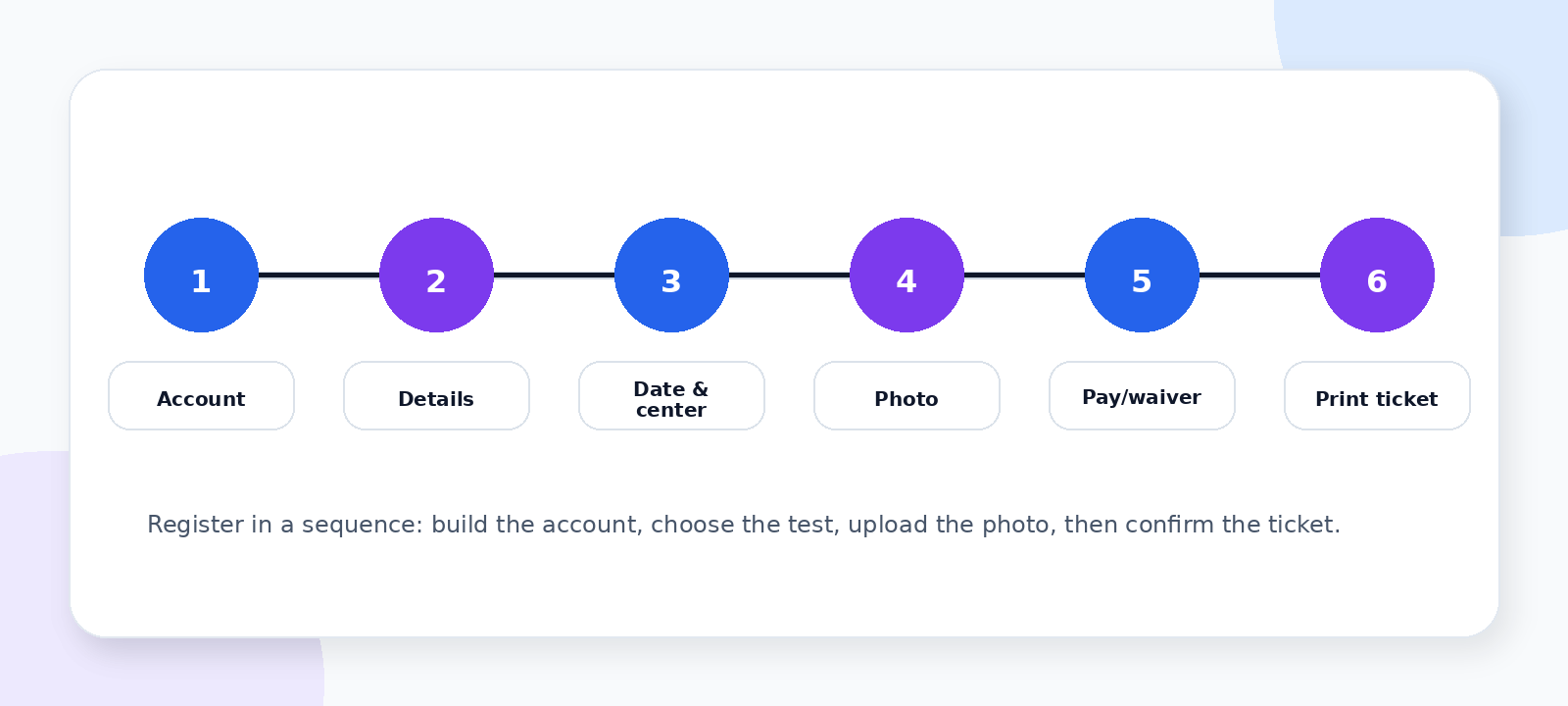
Create or sign in to your College Board account at the official College Board website. This is where you will register, view scores, and send reports.
Enter your personal details exactly as they appear on the photo ID you will bring on test day: full legal name, date of birth, and contact information.
Choose your test date and test center. Use the test-center search to find a location with open seats near you. Popular centers fill early, so book as soon as you know your date.
Upload a recognizable photo that meets the College Board’s requirements. It appears on your admission ticket and is checked at the door.
Pay the registration fee (see below) or apply a fee waiver if you are eligible.
Print your admission ticket and keep it with your ID for test day.
Students testing with accommodations must be approved through the College Board’s Services for Students with Disabilities before registering, so start that request early.
SAT registration fees in 2026
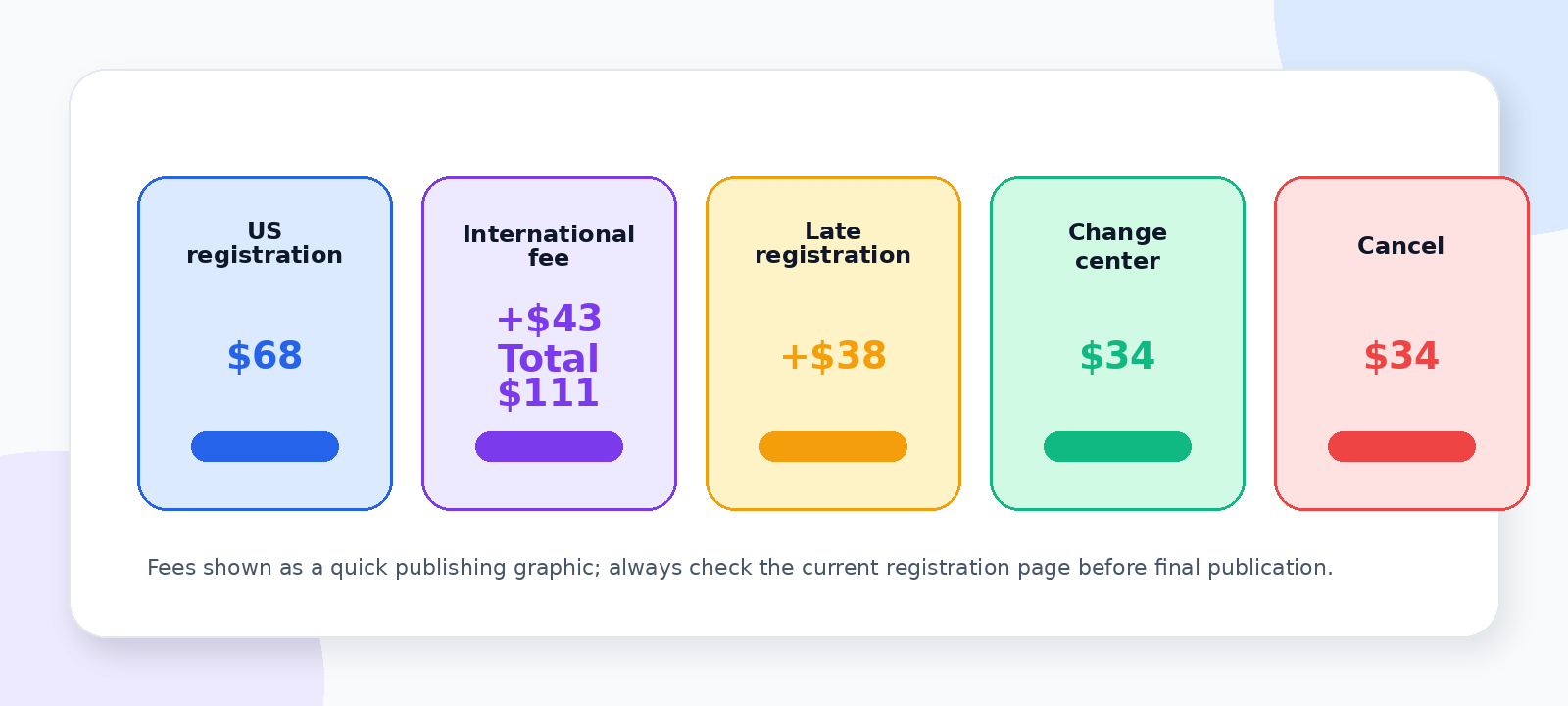
The base SAT fee is $68 for students testing in the United States. Testing at an international center adds a regional fee of $43, bringing the international total to about $111. Other charges apply only if you register late or change your plans.
Fee
Amount
SAT registration (US)
$68
International test center fee
+ $43 (about $111 total)
Late registration
+ $38
Change test date or center
around $29
Cancel registration
around $34
Extra score reports (beyond the free reports)
a few dollars each
Change and cancellation fees vary slightly and are updated periodically, so confirm the current amounts on the College Board fees page before you pay. You may see an outdated figure such as $55 on some third-party sites; the current base fee is $68.
SAT fee waivers
Eligible low-income students in the 11th and 12th grades can register with a fee waiver, which removes the cost entirely and adds benefits. A fee waiver covers registration for two SAT dates, unlimited score reports to colleges, and waived application fees at many participating colleges.
Students using a fee waiver are also exempt from late registration and cancellation fees. Ask your school counselor whether you qualify; counselors can issue waivers directly.
SAT registration deadlines
Each test date has a regular deadline about three weeks before the test and a late deadline about 11 to 12 days before. Registering by the regular deadline gives you the standard fee and the best choice of test centers.
For the full 2026-2027 calendar of dates with their regular deadlines and score-release windows, see our SAT test dates guide. If you need to borrow a device from the College Board, request it at least 30 days before the test.
After you register: getting ready for test day
Once you are registered, your focus shifts to preparation and logistics. Download the College Board’s Bluebook app ahead of time, complete the required exam setup, and review what to bring. Our SAT test day guide walks through the full checklist and timeline so nothing catches you off guard.
Frequently asked questions about SAT registration
Q: How much does it cost to register for the SAT? A: The base fee is $68 in the United States. International test centers add $43, for a total of about $111. Late registration adds $38, and changing or cancelling a registration carries smaller fees that vary.
Q: Can I register for the SAT for free? A: Yes, if you are an eligible low-income 11th or 12th grader. A College Board fee waiver covers two test dates, unlimited score reports, and waived application fees at participating colleges. Ask your school counselor.
Q: Who should complete the SAT registration? A: The student should register, not a parent or counselor, so that every detail matches the photo ID presented on test day.
Q: What do I need to register? A: A College Board account, your legal name and date of birth as shown on your ID, a recognizable photo, a payment method or fee waiver, and your chosen test date and center.
Q: When is the SAT registration deadline? A: The regular deadline is about three weeks before each test date, with late registration open for roughly 11 to 12 days after that for an added $38 fee. Check the current date on the College Board site.